GAEC, KNUST, French Embassy unite AI with nuclear research for Ghana’s growth

In a bid to tackle pressing challenges in agriculture, health, and industry, Ghana is leveraging artificial intelligence (AI) and nuclear science through an innovative partnership with the French Embassy.

The AI for Sustainable Development (AI4SD) project, involving the Ghana Atomic Energy Commission (GAEC) and Kwame Nkrumah University of Science and Technology (KNUST), is transforming cutting-edge research into practical solutions that benefit communities and inform policy.

Funded by the French Embassy, the initiative provides essential equipment, training, and infrastructure to local scientists.

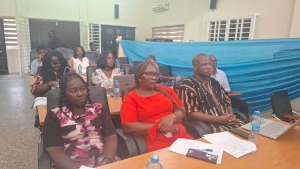
A recent visit by French Embassy officials to GAEC’s facilities in Accra highlighted the project’s progress, showcasing how advanced technologies are being applied to real-world problems.

At the Acceleration Research Centre, the delegation inspected the Tandetron Accelerator, a key tool for analysing materials across various fields. Dr Christian Nuviadenu, manager of the facility, explained its versatility: “Here, we operate a Tandetron accelerator.

“It’s for research, education, and training. We specialise in probing materials to know their content. So those materials can have interest in different fields of application, in medicine, food and drugs, archaeology and cultural heritage.”

He added: “We work for mines and also for food and drugs, look at food composition with respect to contaminations, work on soil and sediment on plants, etc.”

The tour also included the Ghana Research Reactor-1 Centre, a compact 34-kilowatt facility primarily used for neutron activation analysis, research, and training. Converted from high-enriched to low-enriched uranium in 2017, the reactor ensures safety while supporting vital scientific work.

Dr Kwame Gyamfi, a researcher at the reactor, noted: “This 34-kilowatt reactor is mainly used for neutron activation analysis. In 2017, it was converted from high-enriched to low-enriched uranium.”

GAEC’s efforts extend to calibrating radiation equipment for medical and industrial use. Daniel Adjei, an assistant research scientist, described their role: “We calibrate medical and industrial radiation equipment to ensure accurate measurements. This is a secondary laboratory compared to our primary detector.”

“Our services include supporting, for example, health facilities where the radiation is used for medical imaging. In the extractive industry, some mining companies use radiation sources for some of their processes. And so we calibrate all of that equipment to make sure that they are measuring the quantity of radiation that they are measuring,” he elaborated.

Following the lab visits, discussions with GAEC scientists focused on AI’s role in agriculture. Kofi Asare, manager at the Remote Sensing and Climate Centre, highlighted how satellite imagery and AI models assist farmers: “AI helps farmers monitor crops and manage droughts, improving yields in northern Ghana and Bono East.”

The project has equipped an AI lab with computers and resources to support evidence-based studies for government ministries. Prof. Francis Hasford, director of the Radiological and Medical Sciences Institute, said: “Support from the French Embassy allows us to equip the AI lab and back studies with evidence for government ministries.”

Elisabeth Morzadec, project coordinator for AI4SD, emphasised the initiative’s broader aims, stressing how the program intends to strengthen Ghana’s AI ecosystem.

“We want to strengthen the AI ecosystem and highlight our partners’ work as the project reaches its midpoint.”

By combining nuclear science, AI, and local expertise, AI4SD is fostering sustainable development in Ghana. This collaboration not only addresses immediate challenges but also builds a robust research ecosystem, ensuring long-term benefits for policy, industry, and communities across the nation.

Source: Citinewsroom

GAEC and KNUST Join French Embassy to Celebrate One Year of AI4SD Initiative

The Director General of GAEC, Prof. Samuel Boakye Dampare, together with his team, attended a cocktail dinner and exhibition hosted by the French Embassy to mark the one‑year anniversary of the launch of the Artificial Intelligence for Sustainable Development (AI4SD) initiative at the Alliance Française in Accra.

With support from the French Government, the Ghana Atomic Energy Commission and the Kwame Nkrumah University of Science and Technology have been instrumental in applying artificial intelligence to address critical challenges in agriculture, environmental management, public health, energy systems, and other key sectors that contribute to national development.


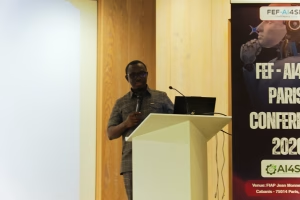
GAEC Participates in AI4SD Conference

The Deputy Director General of GAEC, Prof. Francis Hasford, and Research Scientists from GSSTI-GAEC and RAMSRI-GAEC will serve as distinguished speakers at the “AI for Sustainable Development” programme in Kumasi.

Under the sponsorship of the French government, the programme is slated to take place, from 17–19 February.
As seasoned academics and researchers, Prof. Hasford and his team will bring unparalleled expertise in radiation medicine and space technology as well as other scientific innovations to bear at the conference.

Through the Ghana Space Science and Technology Institute (GSSTI), the Radiological and Medical Sciences Research Institute (RAMSRI) and other Research Institutes of the Commission, GAEC continues to advance the application of artificial intelligence in agriculture, health, water resources management, environment protection, industry, among others. These efforts are strengthening Ghana’s capacity to use nuclear science, spacebased technologies and AI to address challenges in achieving the sustainable development goals (SDGs).

GAEC’s contributions at the event will highlight how the Commission’s scientific leadership, especially through GSSTI, RAMSRI and the other Institutes is helping drive AIpowered solutions that support national development and longterm sustainability for Ghana and the subregion.

By: CPRC/CCD

Land encroachers endangering their lives – GAEC boss warns

The Director-General of the Ghana Atomic Energy Commission (GAEC), Professor Samuel Boakye Dampare, has raised alarm over illegal developments around the National Radioactive Waste Management Centre, warning that human settlements close to the facility pose serious risks to public safety.

Professor Dampare explained that the Centre, which stored radioactive materials used by hospitals and industries, was a highly controlled zone.

“We manage these sources because they are dangerous. People shouldn’t get close to them, but they don’t care,” he said.

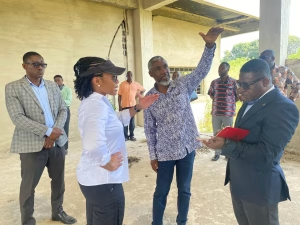
Professor Dampare said this in an interview with the Daily Graphic during an inspection tour of e-waste recycling and related facilities at GAEC last Thursday (January 8), led by the Minister of Lands and Natural Resources, Emmanuel Armah Kofi Buah, who is also the acting Minister of Environment, Science and Technology (MEST).

Nightmare

The problem, Professor Dampare, explained, escalated when individuals and developers began constructing structures near the National Radioactive Waste Management Centre.

“Assuming people are exposed to radioactive materials, the government would have to find money to treat them. And if we have built structures here and an accident occurs, evacuating people would be a nightmare,” he said.

He further stressed that areas housing radioactive sources were considered security zones, and as such were supposed to have constant military presence to prevent unauthorised access.

“These are not ordinary sites. They require security 24/7, but unfortunately, this has not always been the case,” the GAEC boss explained.

The National Radioactive Waste Management Centre, he added, played a critical role in the country’s health care and industrial sectors. Hospitals, for instance, use radioactive sources for diagnostic and treatment purposes, after which the materials are returned to the Centre for safe storage and management.

Professor Dampare lamented that urban development around sensitive sites often took precedence over safety considerations.

“The focus is on buildings and infrastructure, and this attitude is defeating the country. People should understand the danger they are placing themselves in,” he said.

Determination

For his part, the Minister of Lands and Natural Resources, Emmanuel Armah Kofi Buah, reiterated the government’s determination to protect strategic state lands within the GAEC area.

He described some areas as restricted zones due to national security concerns and the presence of toxic materials.

“These lands are not for us alone. This generation will pass and others will come. We cannot behave as if our responsibility is to finish everything simply because we are here,” he said.

Mr Buah added that earlier leaders, including Osagyefo Dr Kwame Nkrumah, deliberately preserved areas such as the GAEC enclave to safeguard Ghana’s future, and warned that the government would not tolerate encroachment.

“They are ‘no-go’ areas. Anyone who enters does so at their own risk.

The Government will do everything to protect these lands in the long-term interest of Ghana,” he cautioned.

Source: Graphiconline

University of Massachusetts Delegation Visits GAEC to Explore Collaboration

A delegation of students and faculty members from the University of Massachusetts, Lowell (UMass Lowell), USA, has paid a working visit to the Ghana Atomic Energy Commission (GAEC) to explore potential areas of collaboration in nuclear energy, health, and water management.

The students and faculty from UMass Lowell, USA, on a guided tour of GAEC’s laboratories during their visit.

The visit was facilitated by Dr. Richard Osei Agjei, Lecturer, University of Education, Winneba and was led by Professor Emeritus of Physics, Robert Giles, and the Dean of the Honors College, Jenifer Whitten Woodring, accompanied by nine students from the University of Massachusetts.

Welcoming the delegation on behalf of the Director-General of GAEC, Professor Samuel B. Dampare, the Director of Commercialisation and Communication, Nana Boateng, provided an overview of GAEC’s mandate and core activities, involving the peaceful application of nuclear science and related technologies in areas including health, agriculture, and energy.

“GAEC remains committed to building strong collaborations that promote knowledge-sharing and innovation in nuclear science and technology. Our research and applications directly support key sectors such as agriculture, medicine, industry, and environmental management” he stated.

Nana Boateng expressed optimism that the visit would serve as a foundation for mutually beneficial collaborations between GAEC and UMass Lowell, particularly in the areas of joint research, capacity building, and student exchange programmes.

In his remarks, Professor Robert Giles explained that his team has been visiting various parts of Africa over the years to identify opportunities for collaboration in nuclear science and engineering.

He expressed hope that the visit to GAEC would help create opportunities for students to gain valuable global research exposure.

“We are seeking opportunities to collaborate internationally in areas such as nuclear engineering and physics. We would welcome the opportunity to establish student exchange programmes between UMass Lowell and GAEC to strengthen both academic and cultural ties,” he said.

As part of the visit, the delegation toured several key facilities at GAEC, including the Personnel Dosimetry Laboratory, the Radon Laboratory, and the Ghana Research Reactor-1 (GHARR-1) Centre.

By CPRC/CCD

Ghana Hosts IAEA’s Deputy Director General in charge of Technical Corporation

The Deputy Director General of the International Atomic Energy Agency (IAEA) in charge of Technical Corporation (TC), Dr. Hua Liu, is in Ghana for a working visit.

He came along with the IAEA Ag. Director of the Division for Africa, Dr. Gashaw Gebeyehu Wolde.

The visit is aimed at strengthening ties with Ghana and to understand the current state of Ghana’s Nuclear Power Programme (NPP), usage of nuclear installations/facilities in the country and to determine other areas of corporation between Ghana and the IAEA.

The Director of the Nuclear Power Institute, Dr. Archibold Buah-Kwofie, making a presentation to (from left to right) Dr. Gashaw Gebeyehu Wolde, IAEA Acting Director of the Division for Africa; Dr. Hua Liu, IAEA Director in charge of Technical Cooperation (TC); and Prof. Samuel Dampare, Director General of GAEC.

The duo was hosted by the National Liaison Officer for the IAEA in Ghana, Prof. Samuel Boakye Dampare, who doubles as the Director General of Ghana Atomic Energy Commission(GAEC).

The first day of the visit took them to the Ministry of Health(MoH), where they had a meeting with the Minister, Hon. Kwabena Mintah Akandoh. It was followed by a visit to the Ministry of Environment Science and Technology (MEST), where they met with the Ag. Deputy Minister, Hon. Alhaji Yusif Sulemana. They then proceeded to the premises of Nuclear Power Ghana (NPG), where they met with the Executive Secretary, Dr. Stephen Yamoah and his team and finally went to the Nuclear Regulatory Authority (NRA), where they met with the Deputy Director General, Prof. Augustine Faanu, and his team.

The discussions at the various Ministries and Agencies focused on possible areas of corporation in health, agriculture, energy, manpower development and environment protection. The discussions also bothered on improving current nuclear facilities and construction of new ones for the benefit of Ghana and the subregion.

Notable among them are the construction of a third radiotherapy center in Tamale, the construction of a children’s hospital and offer of scholarships for training of students in nuclear science and engineering from the undergraduate to graduate levels.

During the tour of the Ministries and Agencies, Institute Directors of GAEC, such as the Director of the Radiological and Medical Sciences Research Institute (RAMSRI), Dr. Theodosia Adom and her team as well as the Director of the Nuclear Power Institute, Dr. Archibold Buah-Kwofie were on hand at the Ministry of Health and Nuclear Power Ghana for discussions.

A team from GAEC, made up of the Director General, Prof. Samuel Boakye Dampare, Director of Administration, Mr. William Srekumah, Head of Legal Affairs, Madam Susana Nyarkoa Addo (Esq) as well as the Head of Communication and Public Relations, Dr. Mark Kwasi Sarfo and his staff accompanied Dr. Hua Liu and Dr. Wolde on their tour.

By: CPRC/CCD


GAEC Hosts Representatives from the French Embassy

The management of the Ghana Atomic Energy Commission (GAEC) welcomed representatives from the French Embassy on Thursday during a courtesy visit by two diplomats to the Commission’s headquarters in Accra.

The visit was aimed at deepening ties between GAEC and the French Consulate to promote research and development.

The team from the French Embassy was led by the Attache for Scientific and Higher Education Cooperation, Ms. Diane Brami and accompanied by the Project Coordinator of the France Team Fund: AI for Sustainable Development, Dr. Elizabeth Morzadec.

Representatives from the French Embassy and GAEC management holding discussions during the visit.

Dr. Elizabeth Morzadec expressed her gratitude to the Management of GAEC and stressed their commitment to promote AI driven research between Ghana and France for the benefit of humankind.

On his part, the Director General of GAEC, Prof. Samuel Boakye Dampare, thanked the team and expressed GAEC’s readiness to partner France for research into areas such as agriculture, health, industry and space science, to mention a few.

“This marks the beginning of bigger collaborations between our two countries”, he added.

Prof. Dampare enumerated a number of projects that have received support from the French and also thanked the team for sponsoring a new PhD. student (Ms, Sandra Agbenyegah) scheduled to be in France for the next six months.

The Deputy Director General of GAEC, Prof. Francis Hasford, gave an overview of the activities of GAEC in a presentation. Highlighting key research activities and contributions that GAEC is making for the socioeconomic development of Ghana.

The team was taken on a tour to visit the Ghana Research Reactors Centre, The Accelerator Research Centre and Secondary Standard Dosimetry Laboratory of GAEC before departure.

By: CPRC/CCD


GAEC Inaugurates Seven Management Boards

The Ghana Atomic Energy Commission (GAEC) has inaugurated the management boards of its six research institutes and a graduate school at a ceremony in Accra to enhance good governance, efficiency, and sustainability.

The institutes are the National Nuclear Research Institute (NNRI), Radiation Protection Institute (RPI), Biotechnology and Nuclear Agriculture Research Institute (BNARI), Radiological and Medical Sciences Research Institute (RAMSRI), Nuclear Power Institute (NPI), School of Nuclear and Allied Sciences (SNAS), and the Ghana Space Science and Technology Institute (GSSTI).

Addressing the gathering after swearing in members of the boards, the Chairperson of the GAEC Governing Board, Professor Abdulai Baba Salifu, urged them to strengthen institutional governance and scientific leadership within the Commission.

He reminded them that the oaths they had taken were solemn commitments to serve with professionalism and to safeguard the public trust vested in them.

Chairperson of the GAEC Governing Board, Professor Abdulai Baba Salifu, addressing the gathering.

Prof. Salifu emphasised the critical role of the newly inaugurated boards in steering the strategic direction of their respective institutes, describing them as “engines of discovery and application” across key national development areas, including health, agriculture, energy, radiation protection, environmental safety, and space science.

He noted that Ghana’s nuclear power agenda, now advancing through Phase II of the International Atomic Energy Agency’s (IAEA) three-phased approach, requires strong institutional governance and scientific leadership.

“Ghana’s pursuit of nuclear energy represents not merely an infrastructure ambition but also an energy-security imperative,” Prof. Salifu stated, adding that the institutes under GAEC would be pivotal in strengthening research, capacity building, and safety frameworks to support the country’s nuclear energy aspirations.

Prof. Salifu further encouraged the institutes to align their activities with national research and innovation priorities, including the National Research Fund, the Feed Ghana Programme, and emerging initiatives such as the Tree for Life Initiative and the National Artificial Intelligence Strategy.

He called for deeper collaboration with universities, industry, and government agencies to ensure GAEC’s scientific research translates into solutions that benefit the everyday lives of Ghanaians.

On his part, the Director-General of GAEC, Prof. Samuel Boakye Dampare, described the inauguration as a reaffirmation of the Commission’s commitment to good governance and institutional efficiency.

“Today’s event is not just a formality; it is a reaffirmation of GAEC’s commitment to good governance, institutional efficiency, and strategic leadership across our research and operational arms,” Prof. Dampare said.

He commended the GAEC Board for its leadership in constituting the new boards and praised the diverse professional expertise of the members, noting that their inclusion demonstrates a strong belief in collaborative governance and evidence-based decision-making.

Prof. Dampare urged the members to work closely with their respective Institute Directors and align their actions with the Commission’s strategic objectives, stressing the importance of transparency, professionalism, and the national interest in all deliberations.

By: CPRC/CCD


Minister Inducts Ghana Atomic Energy Commission Governing Board

On Thursday, August 26, a swearing-in ceremony was held at the Ministry of Environment, Science, and Technology (MEST) to officially induct the newly appointed Governing Board Members of the Ghana Atomic Energy Commission (GAEC).

The ceremony was presided over by the Hon. Emmanuel Armah-Kofi Buah, Acting Minister for MEST, who concurrently serves as the Minister for Lands and Natural Resources, on behalf of H.E. President John Dramani Mahama.

He led the Board members to take the oath of office and oath of secrecy as guiding principles in the discharge of their duties.

Acting Minister of MEST, Hon. Emmanuel Armah-Kofi Buah (middle), in a group picture with newly sworn-in GAEC Board Members.

The seven-member Governing Board will be Chaired by Prof. Abdulai Baba Salifu, with Prof. Francis Gbogbo, Dr. Sena Akosua Yvonne Loh, Prof. Langbong Bimi, Ms. Suweibatu Adam Esq. (Chief Director of MEST), Mr. Albert Quashigah Esq., and Prof. Samuel Boakye Dampare (Director General of GAEC) as members.

In a short statement by the minister, he indicated that the newly inducted Board’s stewardship comes at a critical juncture in Ghana’s Nuclear Power Programme, which is progressing steadily towards the completion of Phase II of the IAEA 3-Phased approach, leading to the ultimate realization of a nuclear power plant to diversify Ghana’s energy generation sources.

“Your commitment to ensuring that the Commission meets international nuclear safety and regulatory standards is crucial, as Ghana works closely with the International Atomic Energy Agency (IAEA) to advance this ambitious national project”, he added.

The Minister also revealed that there were on-going policy processes to review the existing GAEC Act (Act 508) as part of efforts to strengthen and strategically position the Commission to derive maximum benefits from its operations and management. He pledged his maximum commitment and support to ensure that Cabinet and Parliament successfully amend the Act.

“I urge this Board to accord the review process with all the urgency required. The good thing is that with a new Board, fresh ideas, experts advise and insights will be made available to further enrich the document,” he said.

He further charged the board to give urgent attention to the issue of encroachment on GAEC lands. He revealed that the Commission’s lands are critical national assets that host strategic research, training and nuclear facilities, in which encroachment threatens not

only their current operations, but also the future expansion of Ghana’s nuclear programme. Hon. Buah urged the Board to collaborate with MEST, local authorities and other relevant state agencies to implement measures to secure and protect these lands for posterity.

“In carrying out your functmanagement andge you to strengthen research collaborations, promote innovation in the peaceful applications of nuclear technology in areas such as health, agriculture, industry and environmental management, and ensure that GAEC continues to be a centre of excellence in nuclear science and technology on the African continent,” he added.

The Board Chair, Prof. Abdulai Baba Salifu, in an acceptance speech on behalf of all the members thanked the President of Ghana for the opportunity to serve and promised to work hard to enable GAEC achieve all set objectives.

The Professor promised that he and the team will work hard to establish a health facility specializing in using nuclear technologies to treat non communicable diseases. He also promised to support the Commission to establish a nuclear power plant to augment Ghana’s energy sources.

Some Management and staff of GAEC present at the programme were the Deputy Director General, Prof. Francis Hasford, Director of Administration, Mr. William Srekumah, Deputy Director of Finance, Mr. Eli Aniabo, Director of the Radiological and Medical Sciences Research Institute, Dr. Theodosia Adom, Head of Legal Affairs, Madam Susana Nyarkoa Addo, representatives of the Commercialization and Communication Directorate, Dr. Mark Kwasi Sarfo, and Mr. Joshua Yeboah.

By; CPRC/CCD

Landmark Symposium on Naturally Occurring Radioactive Material (NORM) Held in Accra, Advancing Sustainability Across Extractive Industries.

The 11th International Symposium on Naturally Occurring Radioactive Material was held at the Mensvic Hotel in Accra with a focus on planet-friendly solutions in the extractive industry.

The event was under the chairmanship of the Director General of the Ghana Atomic Energy Commission (GAEC) and President of NORM XI, Prof. Samuel Boakye Dampare, and was on the theme, “Broadening Optimization in Industrial Processes Involving NORM: A focus on Sustainability in Extractive Industries.”

Deputy Minister for Lands and Natural Resources, Hon. Alhaji Yusif Sulemana (left), and the Director-General of GAEC, Prof. Samuel B. Dampare (right), in discussions at the symposium.

Ghana is the first Sub-Saharan African country to host an International Symposium on Naturally Occurring Radioactive Material, and marks a significant milestone for the country, positioning it as a global leader in the application and use of NORM for research and development.

The five-day event had experts from around the globe congregating in Ghana to participate and was also graced with the presence of the Deputy Minister for Lands and Natural Resources and Member of Parliament for the Bole-Bamboi Constituency, Hon. Alhaji Yusif Sulemana. He came to represent his boss, the Minister of Lands and Natural Resources and Ag. Minister of the Ministry of Environment Science and Technology, Hon. Emmanuel Armah-Kofi Buah, who is also the Member of Parliament for the Ellembelle Constituency.

In a keynote address, read on behalf of Hon. Buah, he emphasized Ghana’s growing role as a hub for nuclear science and technology in Africa, highlighting the country’s commitment to environmental stewardship and radiation safety.

He noted that NORM are encountered in several key sectors in Ghana, including mining, oil and gas, phosphate manufacturing, cement production, and water treatment.

“While these industries fuel our economy, they also pose environmental and health challenges that require our collective vigilance, innovation, and responsibility,” he stated.

He indicated that the government of Ghana remains firmly committed to supporting research, innovation, and regulation in the nuclear field.

“We will continue to work closely with our international partners, including the International Atomic Energy Agency (IAEA), to strengthen Ghana’s capacity in radiation safety and environmental management,” he added.

He encouraged participants to use the moment to strengthen collaborations, build partnerships, and reaffirm shared responsibilities of ensuring that the benefits of industrial development are achieved without compromising the health and safety of people or the integrity of the environment.

Prof. Dampare also welcomed the participants, reflecting on the evolution of NORM symposia since its inception in Amsterdam, Netherlands, in 1997. He praised the collaborative efforts of GAEC, the Ghana Association for Radiation Protection (GARP), the African ALARA Network (AFAN), and the Nuclear Regulatory Authority (NRA), as well as international partners such as the IAEA, ICRP, ILO, IRPA, and UNSCEAR.
“This symposium marks a milestone not only for Ghana but for the entire region. It is a testament to our shared commitment to optimizing industrial processes while safeguarding human health and the environment,” he added.

He observed a minute’s silence, marking a solemn moment during his speech, as a tribute to the late former Minister for Environment, Science, and Technology, Hon. Alhaji Dr. Ibrahim Murtala Muhammed, who tragically passed away earlier this year, for his support for Ghana’s hosting of NORM XISymposium.

Prof. Dampare expressed his sincere gratitude to the NORM XI Symposium Board, Steering Committee, Local Organising Committee, Scientific Programme Committee, and the invaluable contributions of some private sector sponsors for making this programme a reality. “History will remember your dedication, support, and excellence,” he said.

By: CPRC/CCD