GAEC Hosts IAEA Project Management Officer on HighLevel Working Visit to Ghana

The Ghana Atomic Energy Commission (GAEC) has hosted the Project Management Officer (PMO) of the International Atomic Energy Agency (IAEA), Dr. Amal Elrefaei, on a highlevel working visit to Ghana.

The visit, aimed at strengthening cooperation in the peaceful applications of nuclear science and technology, took place from 20th to 24th April 2026, and sought to review IAEAsupported projects, enhance institutional collaboration, and engage key government ministries, development partners, and stakeholders. It also focused on project monitoring, policy engagement, and strategic discussions across critical sectors including health, agriculture, environment, nuclear regulation, energy, and capacity development.

During the visit, Dr. Elrefaei held engagements with the National Liaison Assistant (NLA) for the IAEA in Ghana, Prof. Francis Hasford, members of the GAEC Executive Committee, coordinators of key IAEA Technical Cooperation projects in accelerator technology, agriculture, and nuclear power development, as well as leaders of Women in Nuclear (WiN) Ghana.

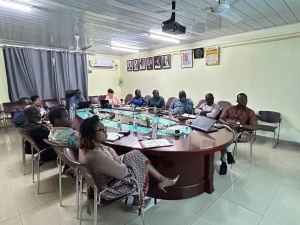
GAEC Management in a roundtable meeting with the IAEA Project Management Officer (PMO), Dr. Amal Elrefaei, during her visit.

At a meeting with the Executive Committee of GAEC, Dr. Elrefaei reiterated the IAEA’s continued support for Ghana in the peaceful applications of nuclear science and commended GAEC for the significant strides made in contributing to Ghana’s socioeconomic development.

She emphasized the importance of initiating preparations for the next Country Programme Framework (CPF) for Ghana, which serves as the strategic document guiding IAEA support to the country.

“The current CPF for Ghana will expire in December 2027, and it typically requires at least one year and two months to prepare a new framework. It is therefore important that preparations begin now,” she noted.

Dr. Elrefaei further encouraged the active involvement of relevant sector ministries during the preparation and implementation of the CPF to ensure alignment with national priorities. She also highlighted the need to engage development partners and donor agencies to strengthen resource mobilization and sustainability.

“Donor agencies should also be included. Please let us know if you require any support in this regard,” she added.

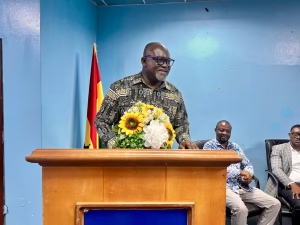
Receiving Dr. Elrefaei on behalf of the National Liaison Officer, who is also the DirectorGeneral of GAEC, Prof. Samuel B. Dampare, the Deputy DirectorGeneral of GAEC, Prof. Francis Hasford, expressed appreciation to the IAEA PMO for the visit.

He reaffirmed GAEC’s commitment to complying with all IAEA regulations and guidelines, both in its operational activities and in the development of the new CPF.

Dr. Elrefaei’s visit commenced with meetings at the Ministry of Health, where discussions focused on the WHO/IAEA Cancer ImPACT Mission and the role of nuclear techniques in public health, particularly in medical diagnostics, radiotherapy, and disease management.

Her engagements also included visits to the Ministry of Environment, Science, and Technology, the Komfo Anokye Teaching Hospital in Kumasi, the United Nations Country Representative Office, the Minister of Food and Agriculture, and the Nuclear Regulatory Authority (NRA).

The visit reaffirms the strong partnership between Ghana and the IAEA and underscores the Agency’s continued commitment to supporting Ghana’s national development agenda through the peaceful use of nuclear science and related technology.

By CPRC/CCD

GAEC Welcomes UK–Africa SAPPHIRE Partners for Radiotherapy Workshop in Accra

The Ghana Atomic Energy Commission has welcomed partners of the SAPPHIRE Project for a week-long workshop at the MENSVIC hotel in Accra, aimed at strengthening radiotherapy capacity across Africa.

With a focus on expanding access to Medical Linear Accelerators (MLINACs) in low- and middle-income countries, the workshop run from April 13 to 18 and hosted by the Radiological and Medical Sciences Research Institute (RAMSRI) of the Ghana Atomic Energy Commission (GAEC).

Funded by Science and Technology Facilities Council (STFC) of the UK Research and Innovation (UKRI), the Supra‑African Physics Partnership for Health Innovation and Radiotherapy Expansion (SAPPHIRE) is a two‑year programme with the main objective of addressing the persistent shortage of highly trained medical physicists and radiation oncologists, as well as the frequent breakdowns of linear accelerator (LINAC) machines in Africa.

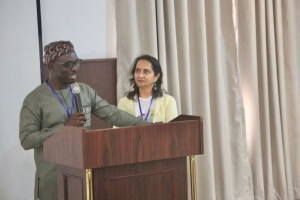
The Acting Director-General of GAEC, Prof. Francis Hasford delivering the keynote address at the workshop.

The workshop brought together medical physicists, clinicians, researchers and other key stakeholders from across Africa, Canada, United Kingdom and the United States to help bridge human resource gap, build sustainable technical and clinical capacity for radiotherapy on the continent and to improve access to and understanding of MLINAC technology, which is critical for the effective treatment of cancer.

Delivering the official opening statement, the Acting Director-General of GAEC, Prof. Francis Hasford, underscored the importance of building local technical expertise to sustain radiotherapy services.

“Reliable cancer treatment depends not only on equipment availability but also on the presence of skilled medical physicists, engineers, and technical professionals who can operate and maintain complex systems effectively”, he stressed.
Prof. Hasford highlighted the SAPPHIRE Project’s collaborative framework, which brings together African institutions and global leaders in accelerator science and medical physics to support innovation, research cooperation, and technology transfer. “This approach ensures solutions are both internationally informed and locally adaptable to the operational realities of African radiotherapy centres”, he added

He further noted that the objectives of the SAPPHIRE Project align closely with Ghana’s national efforts to expand access to quality cancer treatment and strengthen specialized healthcare delivery.

“At the regional level, the project also supports Africa’s broader commitment to equitable access to radiotherapy services through shared learning, cooperation, and collective capacity development among African states” he explained.

By CPRC/CCD

FRENCH EMBASSY DELEGATION VISITS GHANA RADIO ASTRONOMY OBSERVATORY

A delegation from the French Embassy paid a working visit to the Ghana Radio Astronomy Observatory (GRAO) of the Ghana Space Science and Technology Institute (GSSTI) of the Ghana Atomic Energy Commission (GAEC).

The visit, aimed at strengthening scientific collaboration with Ghana in the areas of radio astronomy, artificial intelligence, and space science, was led by the Attaché for Scientific and University Cooperation, Dr. Diane Brami, together with the Project Coordinator for the AI for Sustainable Development (AI4SD) project Ms. Elizabeth Morzadec.

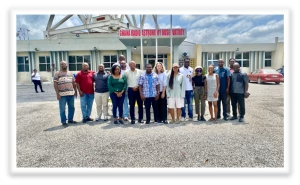
Delegates from the French Embassy and the GRAO team during the courtesy visit to the Observatory.

Welcoming the delegation on behalf of the Director General of GAEC, Prof. Samuel Dampare, the Director of GSSTI, Dr. Joseph Tandor, explained how the 32-metre antenna, was transformed into a functioning radio telescope as part of the Square Kilometre Array (SKA) and the African Very Long Baseline Interferometry  (VLBI) Network initiatives.

“This facility was once an abandoned communication ground station, and it was converted into the radio telescope we have today, making the 32-metre antenna the largest in West Africa and one of the first of its kind in the subregion” he said.

Dr. Tandoh noted that the GRAO project has progressed from its initial focus on technical and infrastructure development to a science-driven phase of conducting single-dish observations to capture radio signals from objects in space.

He added that the facility hosts a Hydrogen Maser and data center as well as processing infrastructure essential for radio astronomy, with plans to expand data capacity and improve access for international researchers.

“The goal is to link our telescope with others across the world so that we can observe the universe collectively and generate more detailed scientific data” he stated.

He added that the observatory plays a vital role in education and public outreach, offering students hands-on experience with real scientific instruments and sparking early interest in astronomy and space science.

“Last year alone, we had more than 3,000 visitors mostly students visiting this facility. When young people see such a place, it inspires them to learn astronomy and physics and thus promoting STEM education. We are also planning to build a planetarium to further enhance public engagement and learning” he said.

Addressing the GRAO team, the Attaché for Scientific and University Cooperation, Dr. Diane Brami expressed appreciation for the tour and commended Ghana’s progress in space scienceand technology.

She emphasised the importance of enhancing mobility programmes for young scientists and promoting knowledge exchange across African countries, noting that such collaborations are crucial for the future of global space science research.

The delegation toured key sections of the Ghana Radio Astronomy Observatory, including the 32 metre radio telescope, the control room, and the data centre.

By: CPRC/CCD


GSSTI CALLS FOR PRACTICAL USE OF SATELLITE DATA TO IMPROVE NATIONAL DEVELOPMENT

The Director of the Ghana Space Science and Technology Institute (GSSTI), Dr. Joseph Tandoh, has called for a shift from discussion to action in the use of satellite and Earth‑observation data to improve the lives of Ghanaians.

He made the call during the opening ceremony of a two-day multi‑institutional stakeholder engagement organised by the Ghana Space Science and Technology Institute (GSSTI) of the Ghana Atomic Energy Commission in collaboration with Digital Earth Africa (DE Africa) in Accra.

The engagement brought together government agencies, private sector and development partners to explore how satellite data can support agriculture, mining regulation, disaster management, health, and environmental protection.

In his opening remarks, Dr Tandoh noted that the time has come for us to move beyond talk and deliver practical solutions that impact the daily lives of Ghanaians.

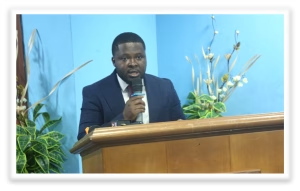
The Director of GSSTI, Dr. Joseph Tandoh, addressing participants at the stakeholder engagement.

“Satellite data should not end on presentation slides. It must be applied to challenges such as agricultural productivity, flood and drought forecasting, coastal monitoring, land administration, and climate resilience” he said.

He explained that this call aligns with Ghana Space Policy, which recognizes space science and Earth observation as strategic tools for development, and emphasizes the need for stronger coordination among government institutions, academia, and research bodies.

Dr. Tandoh mentioned that, as the national institution mandated to coordinate space science activities, GSSTI, is committed to bridging the gap between satellite data access and the computing infrastructure to institutions that need to use the data to generate actionable insights.

“GSSTI cannot do this alone. We need all stakeholders such as ministries, government agencies, academia, and the private sector to work together and develop practical pilot projects that show real value” he emphasized.

Speaking on the practical applications of Earth‑observation data, the Centre Manager of Remote Sensing and Climate Change, Dr. Kofi Asare, highlighted the significant benefits for agriculture and natural resource management.

He stated that satellite‑derived indicators such as soil moisture and vegetation health now make it possible to detect stress on farmlands early.

“The farmer no longer needs to guess. We can identify the exact part of the field with a problem and direct interventions precisely where they are needed” he said.

Dr. Asare noted the growing importance of using satellite data in monitoring and protecting natural resources, especially in mining‑affected areas.

“From sampled data between 2008 and 2024, nearly 60,000 hectares of land has been converted to mining; we can map it, monitor it, and quantify the impact using satellite data and Artificial Intelligence,” he said.

His presentation further highlighted the need to strengthen collaboration within Ghana’s Group on Earth Observations (GhanaGEO) community.

He emphasised the importance of moving from fragmented efforts toward a more coordinated and integrated ecosystem where institutions actively share data and co-develop solutions.

His presentation further highlighted the need to strengthen collaboration within Ghana’s Group on Earth Observations (GhanaGEO) community.

He emphasised the importance of moving from fragmented efforts toward a more coordinated and integrated ecosystem where institutions actively share data and co-develop solutions.

He also stressed the urgent need to transition from decision-making based on perception to one grounded in scientific evidence, noting that satellite-derived data provides a powerful and reliable basis for informed decision-making across sectors.

He further showcased the potential of the Digital Earth Africa platform as a transformative tool for improving access to analysis-ready data and enabling scalable, data-driven applications across agriculture, water resources, urban development, and environmental management.

Contributing to the discussion, the Capacity Development Lead of Digital Earth Africa, Dr. Kenneth Mubea said that Digital Earth Africa provides free, open and accessible Earth‑observation data, enabling governments, researchers and policymakers to carry out high‑quality analysis at national and local levels.

He added that DE Africa’s 30‑year satellite archive helps institutions track environmental change and understand long‑term trends

“The value lies not only in seeing what has changed, but in understanding patterns over time and using that intelligence to guide planning. Our goal at DE Africa is to ensure that satellite data is not locked away in technical systems but applied directly to improve decision‑making,” he explained.

He encouraged the participants to engage actively with DE Africa tools, noting that collaboration and shared access to data are key to improving climate resilience and development across the continent.

Representatives at the engagement included the Water Resources Commission, COCOBOD, Council for Scientific and Industrial Research (CSIR), National Disaster Management Organisation(NADMO), Forestry Commission, Big Data, GhanaMeteorological Agency (GMet) and Ministry of Lands and Natural Resources.

By: CPRC/CCD


AFRA HOLDS REGIONAL WORKSHOP ON MODALITIES FOR IMPLEMENTATION OF IAEA PROJECTS IN AFRICA

The Ghana Atomic Energy Commission (GAEC), on behalf of the Government of Ghana, hosted a high level Regional Taskforce Workshop on the implementation of IAEA regional projects earmarked for Africa at the Mensvic hotel in Accra.

The African Regional Cooperative Agreement for Research, Development and Training related to Nuclear Science and Technology (AFRA). Workshop took place from 23rd-27th March 2026, and brought together representatives from the International Atomic Energy Agency (IAEA), AFRA National Coordinators, Focal Points of Regional Designated Centres (RDCs), and delegates from several participating Member States.

The purpose of the workshop was to review, harmonize, and strengthen training fee structures across AFRA Regional Designated Centres in Africa, a critical step toward improving transparency, equity, and efficiency in the delivery of nuclear science and technology training programmes, which has arisen as a result of increasing demands for academic training, fellowships, and scientific visits under the IAEA Technical Cooperation Programme.

In a welcome statement, the Acting Director General of GAEC, Prof. Francis Hasford, expressed Ghana’s appreciation for the opportunity to host the strategic event, emphasizing the country’s commitment to advancing regional capacity building initiatives.

“Ghana remains firmly committed to supporting AFRA initiatives and advancing regional capacity building in nuclear science and technology. Through GAEC and our national institutions, including our role in hosting training programmes and supporting fellowship activities, we will continue to collaborate closely with the IAEA and Member States to expand opportunities for knowledge exchange and skills development across the continent” he said.

He noted that the meeting comes at a pivotal moment, as Member States collectively seek practical solutions for harmonizing training fees and improving access to high quality training opportunities across the continent.

“As demand continues to grow for long-term academic training, fellowships, and scientific visits across Member States, it has become increasingly important to ensure that training arrangements are transparent, equitable, efficient, and responsive to the needs of our institutions and beneficiaries” he added.

Prof Hasford stressed the importance of ensuring transparency, fairness, and sustainability in training arrangements, especially within the current global economic climate.

The Focal Point for AFRA at the International Atomic Energy Agency, Mr. Mickel Edwerd, in a brief remark, said that it was critical for this meeting to be held to ensure harmony across all the African countries.

He questioned the major disparities existing in the charges among African countries hosting similar programmes and called for a concerted effort to harmonize all the fees across the continent.

“There are so many people who want to pursue their masters and PhDs, but the high fees are preventing us from taking them. Charges in African countries are higher when compared to European or even Asian countries” he stressed.

The workshop provided a platform for participants to discuss best practices related to hosting fellowships and scientific visits, enhance coordination among AFRA RDCs, and strengthen institutional capacities to support the growing number of trainees across Africa.
Member States represented include Algeria, Egypt, Ethiopia, Ghana, Madagascar, South Africa, Tanzania, Tunisia, and Zambia.

By: CPRC/CCD


GHANA AND JAPAN DEEPEN COLLABORATION IN SPACE SCIENCE AND TECHNOLOGY FOR NATIONAL DEVELOPMENT

The Ghana Space Science and Technology Institute (GSSTI) of the Ghana Atomic Energy Commission (GAEC) has held a strategic stakeholder engagement with a Japanese delegation from Cross U (a Tokyo-based space business promotion organization) to strengthen bilateral cooperation in space science and technology.

The Director of GSSTI, Dr. Joseph Bremang Tandor, addressing participants at the stakeholder engagement.

The meeting brought together representatives from academia, government ministries and agencies, industry players, and international partners, alongside the Japanese team. Discussions centered on identifying Ghana’s priority needs in sectors such as agriculture, environmental monitoring, and disaster management, and aligning them with proven Japanese space technology solutions.

Welcoming the participants, the Director of GSSTI, Dr. Joseph Bremang Tandoh, emphasized that space science is globally acknowledged as a crucial driver of the Sustainable Development Goals (SDGs), with applications spanning climate change mitigation, agricultural optimization, disaster risk reduction, urban planning, and environmental protection.

“A significant proportion of the challenges confronting Africa today can be addressed through earth observation, satellite data, and space-enabled analytics. For Ghana, the relevance of space technology is no longer in question, our task now is to scale, localize, and sustain these solutions within our national development agenda to deliver tangible socio-economic benefits,” he stated.

Dr. Tandoh highlighted government’s commitment to advancing space science, citing the approval of the National Space Agency and the signing of a bilateral Memorandum of Understanding (MoU) with Japan as key milestones.

“Today’s engagement builds on a major step forward in Ghana–Japan relations. The MoU on Space Business Cooperation, signed during TICAD 9 in Yokohama, outlines a two-year partnership focused on co-developing space technologies, building human capacity, and fostering sustainable solutions,” he added.

He noted that implementation of the MoU would begin immediately, with the workshop serving as a collaborative platform to identify pilot projects across key national sectors.

“We are gathered here today to hear from all stakeholders. We cannot plan in isolation. By the end of this workshop, we expect to identify cross-sectoral projects and chart a path toward implementation,” he emphasized.

On his part, Mr. Masafuni Yonazu, Secretary General of Cross U, expressed gratitude for the warm reception extended to the Japanese delegation, noting that Ghana’s hospitality reflects a spirit of partnership and sets a positive tone for the collaboration.

He explained that Cross U’s mission goes beyond introducing Japanese space technologies; it seeks to help build a sustainable space ecosystem through open cooperation.

“As we move into the presentations and open exchange session, I encourage candid feedback on local needs. We are eager to identify opportunities for joint projects and capacity building. We also hope this workshop will lay a strong foundation for what we envision as the Japan–Ghana Space Industry Working Group,” he said.

By: CPRC/CCD