The Ghana Atomic Energy Commission has welcomed partners of the SAPPHIRE Project for a week-long workshop at the MENSVIC hotel in Accra, aimed at strengthening radiotherapy capacity across Africa.
With a focus on expanding access to Medical Linear Accelerators (MLINACs) in low- and middle-income countries, the workshop run from April 13 to 18 and hosted by the Radiological and Medical Sciences Research Institute (RAMSRI) of the Ghana Atomic Energy Commission (GAEC).
Funded by Science and Technology Facilities Council (STFC) of the UK Research and Innovation (UKRI), the Supra‑African Physics Partnership for Health Innovation and Radiotherapy Expansion (SAPPHIRE) is a two‑year programme with the main objective of addressing the persistent shortage of highly trained medical physicists and radiation oncologists, as well as the frequent breakdowns of linear accelerator (LINAC) machines in Africa.
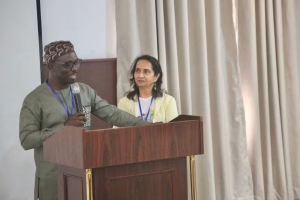
The workshop brought together medical physicists, clinicians, researchers and other key stakeholders from across Africa, Canada, United Kingdom and the United States to help bridge human resource gap, build sustainable technical and clinical capacity for radiotherapy on the continent and to improve access to and understanding of MLINAC technology, which is critical for the effective treatment of cancer.
Delivering the official opening statement, the Acting Director-General of GAEC, Prof. Francis Hasford, underscored the importance of building local technical expertise to sustain radiotherapy services.
“Reliable cancer treatment depends not only on equipment availability but also on the presence of skilled medical physicists, engineers, and technical professionals who can operate and maintain complex systems effectively”, he stressed.
Prof. Hasford highlighted the SAPPHIRE Project’s collaborative framework, which brings together African institutions and global leaders in accelerator science and medical physics to support innovation, research cooperation, and technology transfer. “This approach ensures solutions are both internationally informed and locally adaptable to the operational realities of African radiotherapy centres”, he added
He further noted that the objectives of the SAPPHIRE Project align closely with Ghana’s national efforts to expand access to quality cancer treatment and strengthen specialized healthcare delivery.
“At the regional level, the project also supports Africa’s broader commitment to equitable access to radiotherapy services through shared learning, cooperation, and collective capacity development among African states” he explained.
By CPRC/CCD