The Minister of Environment, Science and Technology, Hon. Dr. Zanetor Agyeman-Rawlings, has urged the Ghana Atomic Energy Commission (GAEC) to strengthen public awareness of its role in national development.
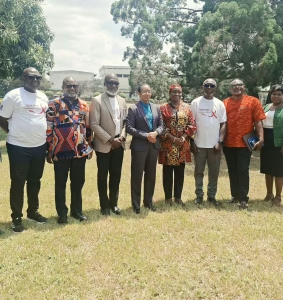
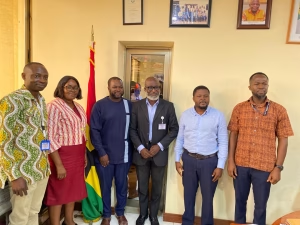
She made the call during a working visit to GAEC, where she engaged Management on the Commission’s activities, achievements, operational challenges and future development plans.
According to the Minister, many people remain unaware of GAEC’s impact on healthcare, agriculture, environmental protection and other critical sectors of the Ghanaian economy, underscoring the need for increased public awareness of the Commission’s work and relevance.
The Minister stated that GAEC’s work extends beyond nuclear research into critical sectors such as healthcare, agriculture, mining and environmental protection, making it important for the public to better appreciate the Commission’s mandate and contributions.
She highlighted the application of nuclear science and related technologies in medical diagnostics, treatment, radiation monitoring, water testing, mining and environmental assessment. She noted that greater public understanding of these applications would enhance appreciation of the Commission’s role in improving lives and supporting economic growth.
“I feel that the public should get to know a little bit more about who you are and what you do because your work contributes to various sectors of the economy,” she said.
The Minister acknowledged the challenge of retaining the specialised expertise required to support the country’s ambitions in nuclear science and technology.
“The field that you occupy is very specialised, and it takes an average of at least 15 years to develop someone to a level where they can make meaningful contributions in this field and do something for Ghana. We should therefore do our utmost to retain such highly skilled persons within our jurisdiction,” she added.
She said that as Ghana advances its plans to deploy nuclear power, investment in infrastructure must be matched by investment in human resource development and retention.
The Minister further assured Management that discussions would continue to address the Commission’s challenges, including concerns about staff attrition and the support required to enhance its operations.
Welcoming the Minister and her delegation, the Director-General of GAEC, Prof. Samuel Boakye Dampare, expressed appreciation for the visit, describing it as a great opportunity to showcase the Commission’s achievements, discuss operational challenges and explore areas requiring government support.
“Your visit provides an important opportunity for us to showcase the impact of nuclear science and related technologies in addressing national development challenges and to share our vision for the future,” he stated.
He reaffirmed GAEC’s commitment to advancing scientific research and applying nuclear science and technology to address national development priorities, particularly in food security, healthcare, environmental protection and nuclear energy development.
As part of the engagement, the Director of the Commercialisation and Communication Directorate (CCD), Nana Boateng, presented an overview of GAEC’s research achievements, facilities, commercial services and ongoing projects.
The Director stated that GAEC, through its Biotechnology and Nuclear Agriculture Research Institute (BNARI), continues to make significant contributions to food security and sustainable agriculture through the application of nuclear and related technologies.
“BNARI has developed nine improved cassava varieties, including Vitamin A-rich varieties, and distributed 10,000 cassava planting materials to farmers to support increased agricultural productivity and improved nutrition,” he said.
He added that advances in tissue culture, mutation breeding, genome editing and smart agriculture were helping to improve crop yields and support national food security efforts.
Highlighting the Commission’s impact on healthcare and radiation science, the Director noted that GAEC continues to support research into major public health challenges, including cancer and malaria.
“GAEC currently operates a nationwide radiation monitoring network with more than 1,000 base stations and has trained 30 medical physicists from 13 African countries, reinforcing Ghana’s position as a regional hub for nuclear science education and capacity building,” he stated.
The Director further disclosed that approximately 2,000 occupationally exposed persons are monitored annually to ensure compliance with radiation safety standards.
On future developments, Nana Boateng outlined several strategic projects aimed at enhancing research capacity, service delivery and commercialisation.
“Key projects currently being pursued by the Commission include the establishment of an Electron-Beam (E-Beam) Irradiation Facility, the expansion of the genome-editing laboratory, refurbishment of the Secondary Standard Dosimetry Laboratory, the development of an Artificial Intelligence Centre of Excellence and initiatives towards the local production of medical radioisotopes,” he revealed.
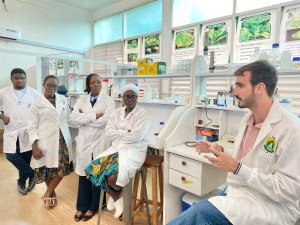
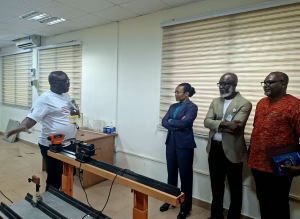
The visit concluded with a tour of selected facilities, including the Personnel Dosimetry Laboratory, Radon Laboratory, Secondary Standard Dosimetry Laboratory (SSDL) and Simulator Training centre, providing the Minister with firsthand insight into the technologies and facilities underpinning GAEC’s contributions to national development.
By: CPRC/CCD