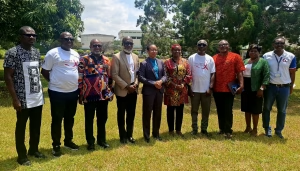
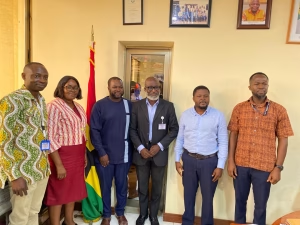
The Ghana Atomic Energy Commission (GAEC), through the School of Nuclear and Allied Sciences (SNAS), hosted the West African commemoration of the 2026 International Day for Disaster Risk Reduction in Accra on Wednesday.
The event, held at the SNAS Conference Hall under the theme, “Building Resilience at Home: The Key to a Safer Household,” brought together disaster management agencies, scientists, policymakers, development partners and stakeholders from across West Africa to promote disaster risk reduction across the region through preparedness and resilience at the household and community levels.
Participants included representatives of the Ghana National Fire Service, Ghana Police Service, Ghana Red Cross Society, Ghana Geological Survey Authority and the National Disaster Management Organisation (NADMO), as well as members of academia and civil society organisations.
The event was organised through a collaboration led by the School of Nuclear and Allied Sciences of the Ghana Atomic Energy Commission (SNAS-GAEC), together with the Africa Science and Technology Advisory Group on Disaster Risk Reduction (AfSTAG-DRR), the Africa Youth Advisory Board (AYAB) on Disaster Risk Reduction in West Africa, the African Union, and the African Partnership Enhancing Discourse and Advocacy for Disaster Risk Reduction (APEDA).
The programme, supported with funding from APEDA and the African Union Commission, was coordinated by Prof. Paulina Amponsah, Chief Research Scientist, SNAS; Prof. Joseph Fianko, Dean, SNAS; Prof. David Kpeglo, Vice Dean, SNAS; and Dr. Amos Forson, Head of the Department, Nuclear Science and Applications, SNAS, whose efforts helped bring together key stakeholders to discuss practical strategies for strengthening disaster preparedness and resilience across the sub-region.
In his welcome address, the Director-General of GAEC, Prof. Samuel B. Dampare, underscored the importance of empowering households and communities to better respond to emergencies and disasters.
He noted that while governments and institutions have critical roles to play, resilience ultimately begins with informed and prepared individuals and families.
“Are we aware of the risks around us? Do we understand early warnings? Do our families know what to do in an emergency? Are our homes and communities adequately prepared?” he asked.
Prof. Dampare noted that strengthening resilience begins with awareness and informed decision-making. He emphasised the need for continuous public education, community sensitisation and practical measures that enable families to respond effectively to emergencies.
Additionally, he observed that West Africa continues to face a range of hazards, including flooding, coastal erosion, landslides, fires, road accidents, conflicts and environmental degradation, necessitating the need for coordinated and proactive approaches to disaster risk reduction.
He also highlighted the contributions of science, technology and innovation to disaster risk management, noting that advances in research and early warning systems can help communities anticipate hazards and take timely action before disasters occur.
“Building resilience requires more than responding when disaster strikes. It demands continuous public education, community sensitisation and capacity building to equip individuals, institutions and communities to anticipate, prepare for and respond effectively to emergencies,” he said.
On his part, the Chairman of the GAEC Governing Board, Prof. Abdulai Baba Salifu, emphasised that resilience is fundamental to human security and sustainable development and noted that resilient households form the foundation of resilient communities and nations, making disaster risk reduction a shared responsibility that extends beyond emergency response agencies.
“Resilience lies at the very heart of human security, and strong households, supported by effective institutions and coordinated public action, are essential to reducing disaster risks,” he said.
Prof. Salifu urged a transition from emergency response-centred approaches to preventive risk management.
“Investments in awareness creation, resilient infrastructure and institutional preparedness remain essential to safeguarding lives and supporting sustainable development,” he added.
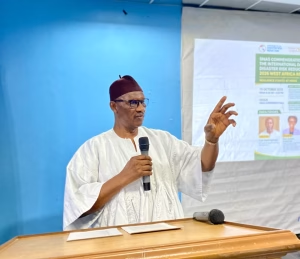
He further underscored the importance of collective responsibility and how effective disaster risk reduction depended on strong partnerships among government agencies, academia, emergency responders, development partners and local communities.
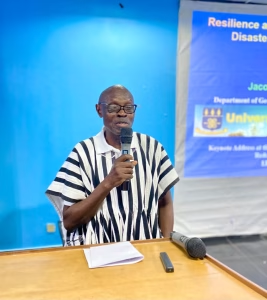
The keynote speaker, Emeritus Prof. Jacob Songsore, drew attention to the role of households as the building blocks of resilient communities. He argued that preparedness efforts are most effective when they are rooted in everyday practices within homes and neighborhoods.
Emeritus Prof. Songsore also said that resilience is shaped not only by national policies and institutional frameworks but also by individual responsibility, household dynamics and community-level leadership.
“The level of the household, the level of the individual responsibility, and the level of domestic governance and power relations all play a critical role,” he stated.
He further emphasised that resilience cannot be imposed from the top down but must be supported through the active participation of households, local authorities, emergency response agencies and development partners working together towards a shared goal of safer communities.
“Embrace disaster risk reduction as a continuous process that requires commitment and preparedness at every level of society,” he added.
The programme featured goodwill messages from participants from Benin, Nigeria, The Gambia and Senegal in solidarity with Ghana and to stress the importance of regional cooperation in addressing shared disaster risks.
It also included keynote presentations, technical sessions, panel discussions and stakeholder engagements focused on disaster preparedness, risk communication, emergency response coordination, community resilience and sustainable development. The discussions provided a valuable platform for participants to exchange experiences, share best practices and explore practical strategies for strengthening household preparedness and enhancing institutional collaboration across the sub-region.
The event was attended by Directors, Deputy Directors, Managers, scientists and staff of GAEC, as well as students of the School of Nuclear and Allied Sciences and pupils of the GAEC Basic School, whose participation underscored the importance of cultivating disaster awareness and preparedness among future generations.
The commemoration concluded with a renewed call for individuals, families, institutions and policymakers to make disaster preparedness an integral part of everyday life.
By: CPRC/CCD