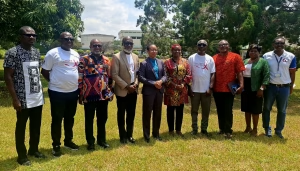
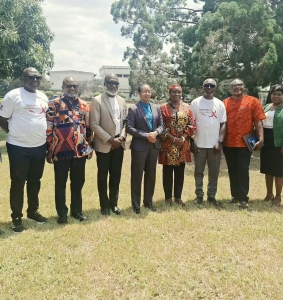
Scientists from the Ghana Atomic Energy Commission (GAEC) and the European Council for Nuclear Research (CERN) have deepened their technical cooperation, with a focus on accelerator research, radiation protection, advanced computing, education and technology transfer.
The collaboration was highlighted during a visit to GAEC by Dr. Martin Gastal, an applied physicist and Advisor to the European Council for Nuclear Research. He was accompanied by Dr. Diane Brami, Attaché for Scientific and Higher Education Cooperation at the French Embassy in Ghana.
Discussions were held with Management and researchers on opportunities for partnerships, training and capacity building. The visit forms part of ongoing efforts to strengthen Ghana’s participation in cutting-edge scientific research and innovation in collaboration with CERN.
It is also part of a broader programme of engagements spearheaded by the French Embassy in Ghana, including meetings with the Ministries of Communication and Education, as well as the Kwame Nkrumah University of Science and Technology (KNUST).
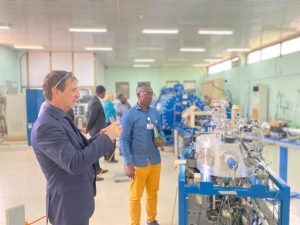
Dr. Gastal, who has worked at CERN for more than two decades, said he sees significant areas of synergy with the work being undertaken by scientists at GAEC.
“CERN is the largest laboratory in the world for particle physics research, and we have a lot of activities that are completely in synergy with what you do, whether it is radiation protection, accelerator technologies, space applications and education,” he said.
He noted that discussions with Ghanaian stakeholders had reinforced the potential for expanding scientific cooperation for mutual benefit.
“I was with the French Ambassador and we focused on GAEC because GAEC can be one of our main partners in science. We spoke about nuclear science, space science and a number of other collaborative initiatives,” he added.
Dr. Gastal also highlighted ongoing collaborations with other Ghanaian institutions and encouraged GAEC researchers to take advantage of available programmes.
“We are always open to collaboration. Universities and research institutions that are proactive can benefit from internships, student exchanges, research projects and other opportunities within the CERN ecosystem,” he said.
Welcoming the duo, Director-General of GAEC, Prof. Samuel Boakye Dampare, said the visit presents an opportunity for both institutions to explore mutually beneficial areas of collaboration.
“We are grateful to you for bringing Martin here. I think there is a lot that we can do together. Looking at what CERN has been doing and what GAEC has also been doing, let us see how best we can explore the opportunities for collaboration,” he said.
The Director-General observed that several of CERN’s areas of expertise align closely with GAEC’s research priorities, including radiation protection, medical applications of nuclear science and technology, environmental research, radioactive waste management, instrumentation and emerging technologies.
As part of the interactions, the Director of Commercialisation and Communication at GAEC, Nana Boateng, explained the activities of GAEC and their socioeconomic importance to Ghana and the subregion in a presentation.
He also noted that the meeting provided an opportunity for both institutions to showcase their capabilities, exchange ideas and explore collaborations that could enhance accelerator science and related research activities in Ghana.
“We will tour GAEC’s accelerator facilities for you to gain a better appreciation of the Commission’s research infrastructure and ongoing work in the field,” he added.
The engagement reflects GAEC’s ongoing efforts to build strategic international partnerships that would enhance the Commission’s research capacity while positioning Ghana as a leader in global scientific initiatives.
In attendance were the Director of the Ghana Space Science and Technology Institute (GSSTI), Dr. Joseph Tandoh; Deputy Director of the National Nuclear Research Institute (NNRI), Prof. Dennis Adotey; Deputy Director of the Radiation Protection Institute (RPI), Prof. Stephen Inkoom; Deputy Director of the Biotechnology and Nuclear Agriculture Research Institute (BNARI), Prof. Samuel Amiteye; Deputy Director of Administration, Mr. Emmanuel Kusi Addo; Deputy Director of the Radiological and Medical Sciences Research Institute (RAMSRI), Prof. Edem Sosu; Deputy Director of the Nuclear Power Institute (NPI), Dr. Charles Kofi Klutse; Manager of the Communication and Public Relations Centre (CPRC), Dr. Mark Kwasi Sarfo; Manager of the Accelerator Research Centre (ARC), Dr. Hyacinthe Ahiamadjie; and Dr. Christian Nuviadenu, Senior Research Scientist.
By: CPRC/CCD