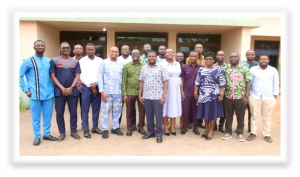
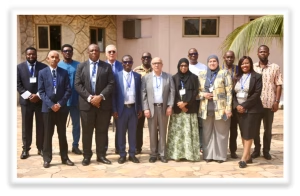
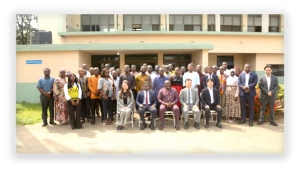
A delegation from the French Embassy paid a working visit to the Ghana Radio Astronomy Observatory (GRAO) of the Ghana Space Science and Technology Institute (GSSTI) of the Ghana Atomic Energy Commission (GAEC).
The visit, aimed at strengthening scientific collaboration with Ghana in the areas of radio astronomy, artificial intelligence, and space science, was led by the Attaché for Scientific and University Cooperation, Dr. Diane Brami, together with the Project Coordinator for the AI for Sustainable Development (AI4SD) project Ms. Elizabeth Morzadec.
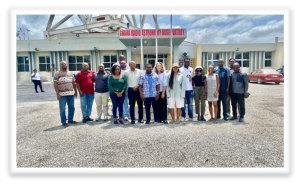
Welcoming the delegation on behalf of the Director General of GAEC, Prof. Samuel Dampare, the Director of GSSTI, Dr. Joseph Tandor, explained how the 32-metre antenna, was transformed into a functioning radio telescope as part of the Square Kilometre Array (SKA) and the African Very Long Baseline Interferometry (VLBI) Network initiatives.
“This facility was once an abandoned communication ground station, and it was converted into the radio telescope we have today, making the 32-metre antenna the largest in West Africa and one of the first of its kind in the subregion” he said.
Dr. Tandoh noted that the GRAO project has progressed from its initial focus on technical and infrastructure development to a science-driven phase of conducting single-dish observations to capture radio signals from objects in space.
He added that the facility hosts a Hydrogen Maser and data center as well as processing infrastructure essential for radio astronomy, with plans to expand data capacity and improve access for international researchers.
“The goal is to link our telescope with others across the world so that we can observe the universe collectively and generate more detailed scientific data” he stated.
He added that the observatory plays a vital role in education and public outreach, offering students hands-on experience with real scientific instruments and sparking early interest in astronomy and space science.
“Last year alone, we had more than 3,000 visitors mostly students visiting this facility. When young people see such a place, it inspires them to learn astronomy and physics and thus promoting STEM education. We are also planning to build a planetarium to further enhance public engagement and learning” he said.
Addressing the GRAO team, the Attaché for Scientific and University Cooperation, Dr. Diane Brami expressed appreciation for the tour and commended Ghana’s progress in space scienceand technology.
She emphasised the importance of enhancing mobility programmes for young scientists and promoting knowledge exchange across African countries, noting that such collaborations are crucial for the future of global space science research.
The delegation toured key sections of the Ghana Radio Astronomy Observatory, including the 32 metre radio telescope, the control room, and the data centre.
By: CPRC/CCD