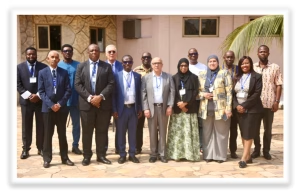
The Ghana Space Science and Technology Institute (GSSTI) of the Ghana Atomic Energy Commission (GAEC) has held a strategic stakeholder engagement with a Japanese delegation from Cross U (a Tokyo-based space business promotion organization) to strengthen bilateral cooperation in space science and technology.

The meeting brought together representatives from academia, government ministries and agencies, industry players, and international partners, alongside the Japanese team. Discussions centered on identifying Ghana’s priority needs in sectors such as agriculture, environmental monitoring, and disaster management, and aligning them with proven Japanese space technology solutions.
Welcoming the participants, the Director of GSSTI, Dr. Joseph Bremang Tandoh, emphasized that space science is globally acknowledged as a crucial driver of the Sustainable Development Goals (SDGs), with applications spanning climate change mitigation, agricultural optimization, disaster risk reduction, urban planning, and environmental protection.
“A significant proportion of the challenges confronting Africa today can be addressed through earth observation, satellite data, and space-enabled analytics. For Ghana, the relevance of space technology is no longer in question, our task now is to scale, localize, and sustain these solutions within our national development agenda to deliver tangible socio-economic benefits,” he stated.
Dr. Tandoh highlighted government’s commitment to advancing space science, citing the approval of the National Space Agency and the signing of a bilateral Memorandum of Understanding (MoU) with Japan as key milestones.
“Today’s engagement builds on a major step forward in Ghana–Japan relations. The MoU on Space Business Cooperation, signed during TICAD 9 in Yokohama, outlines a two-year partnership focused on co-developing space technologies, building human capacity, and fostering sustainable solutions,” he added.
He noted that implementation of the MoU would begin immediately, with the workshop serving as a collaborative platform to identify pilot projects across key national sectors.
“We are gathered here today to hear from all stakeholders. We cannot plan in isolation. By the end of this workshop, we expect to identify cross-sectoral projects and chart a path toward implementation,” he emphasized.
On his part, Mr. Masafuni Yonazu, Secretary General of Cross U, expressed gratitude for the warm reception extended to the Japanese delegation, noting that Ghana’s hospitality reflects a spirit of partnership and sets a positive tone for the collaboration.
He explained that Cross U’s mission goes beyond introducing Japanese space technologies; it seeks to help build a sustainable space ecosystem through open cooperation.
“As we move into the presentations and open exchange session, I encourage candid feedback on local needs. We are eager to identify opportunities for joint projects and capacity building. We also hope this workshop will lay a strong foundation for what we envision as the Japan–Ghana Space Industry Working Group,” he said.
By: CPRC/CCD