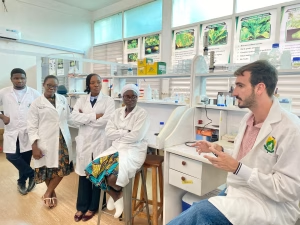
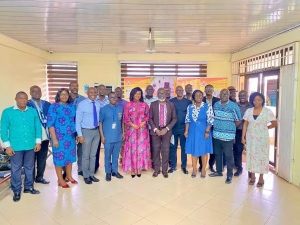
The Ghana Atomic Energy Commission (GAEC), through its Artificial Intelligence (AI) Centre, has organized a training programme in Artificial Intelligence and Robotics for selected Junior High School students of the GAEC Basic School.
The initiative, implemented under the Artificial Intelligence for Sustainable Development (AI4SD) Project and sponsored by the French Government, is designed to equip young learners with foundational knowledge and practical skills in emerging technologies.
The programme aims to prepare students for future opportunities in science, technology, engineering, and mathematics (STEM), while fostering early interest in innovation and problem-solving.
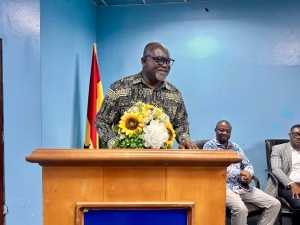
The programme was officially opened by the Director of the Biotechnology and Nuclear Agriculture Research Institute (BNARI), Professor Michael Osae, on behalf of the Director General of GAEC, Professor Samuel Boakye Dampare.
Professor Osae described artificial intelligence as a powerful tool for sustainable development across all sectors of the economy, citing its growing use in areas such as financial technology, agriculture, and irrigation systems.
“What was once considered science fiction has now become a reality,” he remarked.
Professor Osae further cautioned students on the ethical implications of artificial intelligence, stressing the importance of responsible and positive application.
“AI can be used for both good and bad. As young people, you must learn to apply it ethically and for the benefit of society,” he advised.
He encouraged students to practice consistently and take their early exposure to AI and robotics seriously, noting that such dedication could open doors to international opportunities, including global robotics competitions.
Delivering the welcome address, the Director of Administration, Mr. William Srekumah, described the programme as a unique opportunity to expose students to essential technological competencies critical for national and socioeconomic development.
He emphasized that artificial intelligence and robotics have become central to modern problem-solving, job creation, and economic growth and encouraged the students to take full advantage of the opportunity and to actively engage throughout the training.
“Technology has advanced to the point where you can experience artificial intelligence at a very early stage. Ask questions and make the most of this remarkable opportunity,” he urged.
He also expressed gratitude to the French Government for its support of the initiative.
Providing an overview of the training programme, the Deputy Director of the Ghana Space Science and Technology Institute (GSSTI), Dr. Theophilus AnsahNarh, introduced participants to the basic concepts of artificial intelligence and robotics. He explained that the training would emphasize handson learning through the use of microcontrollers, sensors, simulations, and practical demonstrations.
According to Dr. AnsahNarh, students will engage in simulations such as traffic light systems, robotic movement, and virtual drone construction, gradually building a strong conceptual foundation that could lead to programming skills in subsequent phases of the training programme.
“From now until December, we will roll out a series of activities to build your interest and capacity step by step,” he noted.
The Chairman of the GAEC Basic School ParentTeacher Association (PTA), Mr. Nana Ato Hope, also addressed the students, highlighting the rapid growth of artificial intelligence and its increasing application across sectors including healthcare, agriculture, manufacturing, finance, and education.
He observed that technological advancement is steadily reducing reliance on manual labour and reshaping the global workforce and noted that training in AI and robotics is often costly and urged the students to remain committed and focused.
“Opportunities like this are rare and not accessible to everyone. Make sure you make the most of it,” he advised.
By: CPRC/CCD