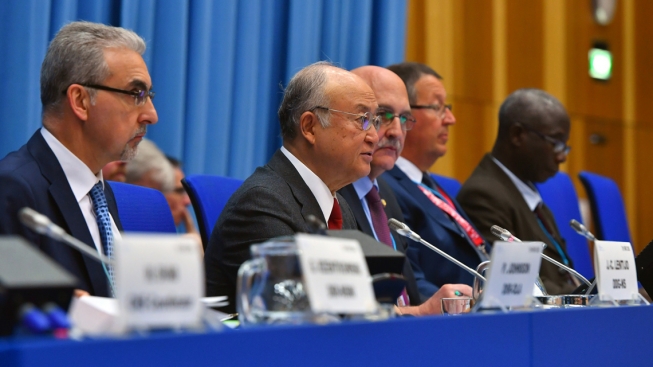
CNS: Review Meeting Identifies Ideas to Improve Nuclear Safety

The Seventh Review Meeting of Contracting Parties to the Convention on Nuclear Safety was held from 27 March to 7 April 2017 at the IAEA Headquarters, in Vienna, Austria. (Photo: D. Calma/IAEA)

Contracting Parties highlighted the importance of sustaining and enhancing a nuclear safety culture, maintaining effective legal frameworks, and enforcing safety precautions within the supply chain following a two-week review of nuclear power plant safety.

Following intensive discussions and reflections on the national reports of nuclear safety programmes from 79 countries, delegates at the Seventh Review Meeting of the Contracting Parties to the Convention on Nuclear Safety (CNS), identified and offered ideas to ensure achievement of high levels of safety. These included ideas to address financial and human resource constraints, safety concerns related to ageing nuclear facilities, and the need for harmonized cross-border emergency planning approaches.

In their Summary Report released at the close of the 27 March – 7 April meeting, Contracting Parties also encouraged the IAEA to continue developing guidance to help countries strengthen regulatory body oversight and practice safety culture.

“Maintaining nuclear sagety requires long-term commitment and vigilance from countries, as well as effective mechanisms for early detection and assessment of problems and networks for sharing lessons learned,” said Juan Carlos Lentijo, IAEA Deputy Director General and Head of the Department of Nuclear Safety and Security.

Referring to the need to maintain oversight of the supply chain to ensure safety, he said.

“This is a common issue both for countries operating nuclear power plants and those considering nuclear power programmes, because of the lack of availability of identical replacement parts and the need to be able to detect non-conforming, counterfeit, suspect or fraudulent items. Furthermore, with the number of nuclear-grade certified suppliers diminishing, access to manufacturers able to meet nuclear standards will become more challenging.”

Contracting Parties acknowledged the value of the CNS review meetings and other voluntary international peer review processes in encouraging continuous self-assessment and improvement.

“These processes effectively unearth the wealth of experience that countries have on nuclear safety issues, and this is helpful for both countries operating nuclear power plants and those just embarking on nuclear programmes,” said Ramzi Jammal, President of the Review Meeting and Executive Vice-President of the Canadian Nuclear Safety Commission “It is important for the IAEA and other organisations to cooperate to strengthen and enhance the effectiveness and efficiency of these reviews.”

Obligations under the CNS

The Convention entered into force on 24 October 1996, setting international benchmarks in the areas of nuclear installation siting, design, construction and operation, as well as financial and human resources, safety assessment and verification, quality assurance and emergency preparedness. It requires Contracting Parties to report on their implementation of obligations under the Convention and subject these reports to peer review by other Parties.

In its first decade, CNS Review Meetings focused heavily on specific technical safety issues. In recent years, the focus has shifted to continuous improvement of nuclear safety.

The CNS Contracting Parties hold Review Meetings every three years. The 8th Review Meeting will take place in 2020.

DG’s Welcome Address: Integrated Nuclear Infrastructure Review Mission – Phase 1

WELCOME ADDRESS BY PROF. B.J.B. NYARKO, DEPUTY GNPPO CHAIRMAN AND DIRECTOR GENERAL OF THE GHANA ATOMIC ENERGY COMMISSION, ON THE OPENING CEREMONY OF GHANA’S PHASE 1 INTEGRATED NUCLEAR INFRASTRUCTURE REVIEW (INIR) MISSION; JANUARY 16- JANUARY 23, 2017.

Mr. Chairman

Dr. Nii Moi Thompson, CEO of NDPC

Experts from the International Atomic Energy Agency

GNPPO Board members

Chief Executive Officers and Institutional Reps.

Directors of Various Institutes

Representatives from the various stakeholder Organisations

Friends from the media

Distinguished Ladies and Gentlemen;

It is a great honor and privilege for me to welcome you to the opening ceremony of Ghana’s phase 1 Integrated Nuclear Infrastructure Review mission. Let me use this opportunity, on behalf of Ghana and the Ghana Nuclear Power Programme Organisation, to extend my warm welcome to the team of experts from the International Atomic Energy Agency and all participants.

The goal of this IAEA coordinated International peer review is to conduct a holistic evaluation of Ghana’s nuclear infrastructure on the basis of 19 Infrastructure issues of NPP development and subsequently provide suggestion and recommendations to fill gaps that may exist.

It is worth noting that Ghana satisfied a preceding requirement of conducting and submitting a self-evaluation report (SER) to the IAEA.

Mr. Chairman, we satisfied this requirement with serious focus on the quality of the Self Evaluation Report and the active involvement of all relevant stakeholder organisations. It is gratifying to note that as a country, we were far advanced with the assessment of our 19 infrastructure issues when we made an official request to the IAEA on 3rd December 2015 to carry out the Phase 1 integrated Nuclear Infrastructure Review Mission (INIR).

I am very happy to inform you that Ghana had a preliminary INIR mission from August 8 to August 10, 2016 and we are hopeful that the general conclusions and recommendations from the IAEA experts would make this main mission a better one.

The IAEA team of experts will give a briefing on the mission implementation and agenda at the opening session and there would be discussions and interviews between and among IAEA experts and GNPPO stakeholder representatives for each of the nineteen (19) infrastructure issues.

Mr. Chairman, may I assure participants that there would be long sessions that will require total commitment and attention and these will culminate in the exit meeting where results and recommendations would be discussed.

Mr. Chairman, it is a well-known fact that a large number of people in sub-Saharan Africa do not have access to electricity, and for those that have access, reliability, sustainability and cost issues have become very compelling. Indeed, almost every problem facing a developing nation is also an energy access problem: agriculture, health, education, lack of productive industries for economic growth among others.

Ghana’s growing energy demand, worsened by rapid population growth, industrialization and major infrastructural development, requires a comprehensive assessment of our energy infrastructure, available energy sources and how they could be exploited in the short, medium and long-term.

Our quest to find a lasting solution to our energy problems has brought into perspective nuclear energy and our first President’s vision on energy. Our focus on the United Nation’s sustainable development goal seven (7) which emphasises access to affordable, reliable, sustainable and modern energy for all and indeed the effect sustainable energy would have on the other goals cannot be gainsaid.

The revitalization of our first President’s vision of exploiting nuclear energy for electricity generation started with the setting up of a Presidential Committee in 2007 known as the Adjei Bekoe Committee, which was tasked to advice government on the potential use of nuclear energy for electricity generation in Ghana.

Mr. Chairman, the compelling and instructive conclusions of the Committee’s report, which led to Cabinet’s decision in 2008 to include nuclear energy into Ghana’s energy mix, are:

  1. A decision by the country to explore nuclear energy for electricity generation would be natural progression in the country’s technological advancement;
  2. The introduction of nuclear power in Ghana’s fuel supply mix will improve our energy security and would be vital in sustaining the energy requirements of a middle income economy.

The Committee also recommended the setting up of a Presidential Commission on Nuclear Power Development (PCNPD) to prepare a draft Nuclear Power Policy and terms of reference for the additional technical and financial feasibility studies; the establishment of a legal framework and regulatory body; accedence to international agreements relating to non-proliferation, physical protection, nuclear safety and security as well as civil liability regime.

Mr. Chairman, it is gratifying to note that the government of Ghana subsequently set up Ghana’s NEPIO, Ghana Nuclear Power Programme Organisation. The government passed a comprehensive nuclear law, NRA Act, 2015 (Act 895) which preceded the establishment of an independent regulatory authority. Ghana, with the help of GNPPO’s legal stakeholder institutions and with the support of the IAEA, has acceded to a lot of international conventions and instruments in connection with non-proliferation, physical protection, nuclear safety, and security.

We know as a nation we can, and must pursue all the possible energy sources that are affordable, sustainable and reliable, while paying attention to carbon emissions and climate change concerns.

We are aware of the tremendous effort required, and the large investment costs and human capacity building but we are encouraged by the vision of our first President, the commitment of our governments and the enthusiasm and industry of our NEPIO, the jobs we will create, the foreign investment we will send to rural areas and the contribution we will make to reducing climate change. I dare say we simply cannot disappoint with the second opportunity to add Nuclear energy to our energy mix, after the efforts of Osagyefo Dr. Kwame Nkrumah our first President.

It is important to state our commitment to safety, security and safeguards requirements and for which reason the IAEA’S methodology of covering 19 key infrastructure issues, in 3 phases and with 3 milestones, is critical to us.

Mr. Chairman let me refer to a quote from Jessie Owens: “We all have dreams but in order to make dreams come into reality, it takes an awful lot of determination, dedication, self-discipline, and effort.” It is the industry and tiring efforts of the GNPPO and NPI that has brought as this far. We acknowledge every member of the GNPPO for their individual and collective efforts that have made this dream a reality. Vince Lombardi, a former American footballer said “The only place success comes before work is in the dictionary”. This quote has indeed found a practical meaning.

Mr. Chairman, when people have worked so hard, it is difficult to find words to encourage them to do more but I have found one; perseverance!!! That is what will take us to the finishing line and what posterity will cherish.

Before I conclude, may I express our appreciation to the IAEA and their experts for their support and to encourage Ghana’s NEPIO to continue with the good work. Much appreciations to our sponsors: the Volta River Authority, Environmental Protection Agency, Tropical Cable and Conductor Ltd, Asanko Gold Gh. Ltd Project, Berock Ventures Ltd, Ghana Chamber of Mines, Engineering Services Providers Co. Ltd and Cornerstone Capital Advisors Ltd.

Finally, on behalf of Ghana and the Ghana Nuclear Power Programme Organization, I welcome you all to Ghana’s first Integrated Nuclear Infrastructure Review mission. I wish you all fruitful discussions and look forward to having outcomes that will help propel us into the next phase of the programme.

Thank you for your attention.

INIR Mission Brief: Integrated Nuclear Infrastructure Review Mission – Phase 1

In December 2015, the Ghana Atomic Energy Commission (GAEC) acting on behalf of the Ghana Nuclear Power Programme Organisation (GNPPO) requested the International Atomic Energy Agency (IAEA) to carry out a Phase 1 Integrated Nuclear Infrastructure Review (INIR) Mission in Ghana, which the IAEA agreed to conduct in January 2017.

The INIR service is designed to assist Member States, upon request, in evaluating the status of their national infrastructure for the introduction of a nuclear power programme or the expansion of an existing one. The INIR service is coordinated and led by the IAEA and conducted by a team of IAEA staff and international experts drawn from Member States who have experience in different aspects of developing nuclear power infrastructure in a safe, secure and sustainable manner.

The first INIR mission was conducted in 2009, and so far, twenty one (21) of them (Phase 1 or Phase 2 or a Follow-up of a previous INIR mission) have been conducted in 15 Member States. Of these, four (4) were in Africa: namely, South Africa (2013, Phase 2), Nigeria (2015, Phase 2), Kenya (2015, Phase 1), and Morocco (2016, Phase 1). The

Ghana INIR mission and associated activities are supported by the Government of Ghana and the IAEA through the national Technical Cooperation Project GHA2003 “Establishing Nuclear Power Infrastructure for Electricity Generation (Phase III)”.

The INIR mission seeks to perform an independent and objective review of the status of the 19 nuclear infrastructure issues in Ghana for Phase 1 of the programme, and is not intended to be an external audit or endorsement of the country’s nuclear power programme. Its main goal is to help Ghana determine the status of its nuclear power infrastructure and identify areas needing further action and assistance, and thereby assist Ghana and its programme partners to focus on needed actions to enable the achievement of the Phase 1 milestone.

The INIR service consists of 4-steps, namely: 1) The preparation of a Self-Evaluation Report (SER), and if required the conduct of a SER support mission; 2) the conduct of a Pre-INIR mission; 3) the conduct of the INIR mission; and 4) the Follow-up to the INIR mission. Ghana’s initial SER was submitted in early April 2016 with associated supporting documents, and a SER support mission and a Pre-INIR mission were conducted in August 2016. Based on comments from the SER support mission, Ghana’s SER was revised and re-submitted with supporting documents in early December 2016.

Ghana signs its third Country Programme Framework (CPF) for 2017 – 2021

signing2Dr. Kwaku Aning, Governor of Ghana, IAEA Board of Governors and Mr Dazhu Yang, IAEA Deputy Director General and Head of the Department of Technical Cooperation, have signed the Ghana Country Programme Framework (CPF) for the period of 2017 – 2021 on 28 September 2016.

A CPF is the frame of reference for the medium-term planning of technical cooperation between a Member State and the IAEA and identifies priority areas where the transfer of nuclear technology and technical cooperation resources will be directed to support national development goals.

Ghana has been an IAEA Member State since 1960. Its 2017 – 2021 CPF identifies 8 priority areas:

1. Food and agriculture
2. Human health and nutrition
3. Water resources and environment
4. Energy and nuclear power development
5. Human resource development and education
6. Industrial applications
7. Nuclear and radiation safety and nuclear security
8. Radioactive safety and waste managementgroup

OCPA Internal Staff Training Programme

[vc_row][vc_column][icon_timeline][icon_timeline_item time_title=”22nd June 2016″]TRAINEES: GAEC Secuity

RESOURCE PERSONS: Selected Scientists from Institutes[/icon_timeline_item][icon_timeline_item time_title=”29nd June 2016″]TRAINEES: GAEC Basic School

RESOURCE PERSONS: Selected Scientists from Institutes[/icon_timeline_item][icon_timeline_item time_title=”6th July 2016″]TRAINEES: GAEC Sanitary

RESOURCE PERSONS: Selected Scientists from Institutes[/icon_timeline_item][icon_timeline_item time_title=”13th July 2016″]TRAINEES: GAEC Horticulture

RESOURCE PERSONS: Selected Scientists from Institutes[/icon_timeline_item][icon_timeline_item time_title=”20th July 2016″]TRAINEES: GAEC Transport Unit

RESOURCE PERSONS: Selected Scientists from Institutes[/icon_timeline_item][icon_timeline_item time_title=”27th July 2016″]TRAINEES: GAEC Hospital

RESOURCE PERSONS: Selected Scientists from Institutes[/icon_timeline_item][icon_timeline_item time_title=”3rd August 2016″]TRAINEES: GAEC Secretariat

RESOURCE PERSONS: Selected Scientists from Institutes[/icon_timeline_item][/icon_timeline][/vc_column][/vc_row]

THE GENE TECHNOLOGY AND AGRICULTURE DEVELOPMENT IN GHANA: PROSPECTS AND CHALLENGES

ProggABSTRACT


TOPIC: THE GENE TECHNOLOGY AND AGRICULTURE DEVELOPMENT IN GHANA: PROSPECTS AND CHALLENGES.

SPEAKER: PROF. K. E. DANSO (DIRECTOR – BNARI).


The adoption of the Gene technology in crop improvement programme has resulted in tremendous crop yield and huge economic returns in many countries. The technology thus ensures food security, increases nutritional quality as well as sustainable environmental management in the midst of changing climate and limited land availability. Although the basis of the technology does not far deviate from Mendellian genetics and hence other known breeding techniques, critics have raised concerns on the adoption of the technology especially in the developing countries. There are arguments that food produced through the gene technology may pose health hazards, introduce super weeds and erode subsistence farmers of their traditional seeds. This presentation will discuss the genetic basis of the technology and the role of Biotechnology and Nuclear Agriculture Research Institute (BNARI) in the development of the technology in Ghana. The public concerns on the gene technology and the regulatory role of biosafety to ensure that food produced via the technology is safe for both human health and the environment.

3rd Regular Lecture

[embeddoc url=”https://gaecgh.org/en/wp-content/uploads/2016/06/PROGRAMME-GAEC-LECTURE-3.docx” height=”700px” viewer=”microsoft”]

Terms of reference for consultancy services

MONITORING AND EVALUATION FOR PROJECT OUTCOME AND INDICATOR WITH RISK ASSOCIATED WITH THE PROJECT AND METIGATING MEASURES FOR THE TECHNOLOGY TRANSFER PROJECT

1.0. BACKGROUND TO THE PROJECT

It is widely recognized that the performance of a national economy in terms of innovation and productivity is not only the result of its basic research capabilities and inventions but also strongly influenced by its ability to exploit these inventions commercially and develop them into products.

The role of academic and research institutions have witnessed continuous change from the production of academic knowledge to ‘capitalization’ of the knowledge with the objective of improving national economic development as well as the institutions own finances. In Ghana, there has been a lot of concern about the gap between scientific achievement and the commercialization of such achievements for the benefit of industry to stimulate national economic transformation[1] Indeed, the role of universities and research institutions in fostering technology transfer and economic growth is now considered a key element of national economic development policies. The Ghana Industrial Policy for instance observed: “There is a weak science, technology and innovation system, with limited interactions between key agents in the system such as universities, research and technology transfer institutions, and industry”

In response, the Government of Ghana has initiated a number of interventions geared towards realizing the objectives set out in the Ghana Industrial Policy. One such notable initiative is the establishment of the fund under the Ghana skills and technology development project where research institutions could team up with industry to transfer knowledge and technology for economic development. The structure of the university and research institutions as the basic platform makes the relationship with the industry easy to develop as there are many programs that can be created. Against this background, GAEC has a number of technological innovations of commercial value which it intends leveraging for the growth of the Ghanaian private sector.

2.0 DESCRIPTION OF THE PROJECT

To address the needs of the private sector and contribute strongly to the growth of the Ghanaian economy, GAEC launched a project “making GAEC more responsive to the demands/needs of Ghana private sector” or simply put “Technology Transfer and Marketing Centre Project” commenced in January 2014 to run for two year duration. The project is being supported by the World Bank through the Ministry of Science and Environment and COTVET.

The main goal of the project is to enhance the transfer of science and technology to the Ghanaian private sector with three key expected outcomes:

  • Establishment of private-sector oriented staff and institutional incentive schemes at GAEC that encourage the providers to respond effectively to technology demand from the private sector
  • Development of Additional and Effective engagements between the private sector and GAEC
  • Building the capacity of the GAEC to develop, adapt and diffuse technologies to the private sectors

The TTMC project adopts the market-driven approach to science and technology research through the establishment of modern technology commercialization and marketing centre (TCMC) that would serve as an interface between the various institutes and the private sector.

The Centre would be well resourced with requisite logistics and qualified personnel; incentives and performance targets. The project would identify and train technology commercialization (TC) focal persons in each institute to coordinate its commercialization activities. The TCMC would facilitate linkages with industry under structured and value for money framework. The technology commercialization centre would develop a technology transfer process guidelines for GAEC. The Centre would also be responsible to conducting analysis of the potential commercial market for each innovation, conduct literature and patent searches to help assess patentability, and evaluate possible commercialization strategies that provide a suitable financial return to GAEC. It would also protect the intellectual property surrounding inventions; define the best commercialization strategy and look for the potential commercial partners to develop the technology into a successful product.

To orient scientists to the new approach to innovation and research at GAEC, the project would provides short training courses in commercialization and marketing to TC focal persons and Directors of Institutes. Topics to be covered include marketing for science and technology ventures; intellectual property and legal issues in commercialization, commercialization of science and technology and entrepreneurship for science and technology ventures. The training would be delivered at SNAS with experts sourced from reputable institutions such as GIMPA or abroad. The project would also collaborate with SNAS to institutionalize this training for all its post graduate students.

To ensure a motivated workforce, the project would review the reward and promotion system at GAEC to go beyond scientific publications to include the provision of science-based solutions to problems facing the private sector. Thus scientists and staff of GAEC would not only be assessed (for promotion) based on the number of publication made but also, the number of technology solutions provided to industry. Further, incentive schemes would be put in place (under this project) to fund the commercialization transfer cost as well as give bonuses to scientists and commercialization personnel who successfully transfer technology to the private sector. The Centre would also support scientists and private sector companies to source for funding from sources such as SDF, Out grower and Value Chain Fund, EDAIF and Venture Capital Fund to develop the innovation. The GAEC mango farmers’ collaboration provides an example.

To get scientists to be abreast with the pressing technological problems facing the private sector, the project would organize bi-annual workshops which would bring scientists and key industrial actors together. GAEC website would be upgraded and regularly updated to include the various innovations/technology churn out by the institutes. Information and communication materials would also be developed and distributed to potential private sector companies. A number of public relation engagements would be carried out to further promote the various innovations at GAEC both in the print and electronic media. The project

The project thus represents a point of departure in terms of how scientific researchers are conducted at GAEC and the beginning of enduring relationship between GAEC and the private sector in Ghana.

OBJECTIVES OF THE ASSIGNMENT

  1. To presented here are the expected end of project situation; what resources, infrastructure, capacity, processes etc. are in place to ensure continuity and how and why the outcome of this project will be Monitored and Evaluated.

SCOPE OF WORK

Specifically the Consultant is expected to undertake the following:

  1. Make consultation with the Scientist who has benefited from the grants from the Center, Monitor its progress and Evaluate with its achievements to understand and recommend an efficient and effective evaluation plan
  2. Develop technology, transfer and commercialization evaluation guidelines for the grants under implementation that clearly outlines the 0utcome from idea conception to market.

METHODOLOGY

The consultant is to come up with sound methodology including the use of participatory approaches in carrying out this assignment. The consultant should seek the views and opinion of GAEC management and staff to fully understand the context in coming up with the Evaluation and Monitoring plan.

DELIVERABLE

  1. A work plan for delivering on the Terms of reference with brief methodology
  2. Final report within 3 weeks of commencement of assignment.
  1. RESPONSIBILITIES

GAEC:

  1. To provide any organizational related information that the consultant may need to carry out assignment expeditiously
  2. To pay the consultants agreed fees
  3. Create platforms for briefing of management /staff on the draft report
  4. Support the Consultant interview appropriate individuals.
  1. Contact persons

The consultant shall report to:

Ms. Sheila Frimpong

Project Coordinator

TTMC

f_shillahumble @yahoo.com

Tel:0246171271