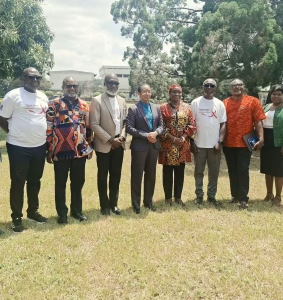
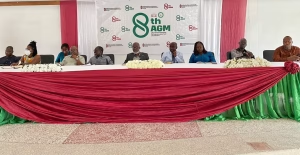
The Ghana Atomic Energy Commission (GAEC) on Tuesday launched the 2026 Cancer Awareness and Screening Campaign with a call on Ghanaians to prioritise regular cancer screening for early detection.
The campaign is being organised by the Radiological and Medical Sciences Research Institute (RAMSRI) of GAEC, in collaboration with the GAEC Hospital.
Held in Accra on the theme, “Your Health Matters: Get Screened,” the campaign seeks to promote public education on cancer prevention, early detection, diagnosis and effective treatment, with particular emphasis on breast and prostate cancers.
The initiative will also provide free screening services and extend cancer awareness activities to communities across the country to encourage early detection and timely medical intervention.
Speaking at the launch, the Chairperson of the GAEC Governing Board, Professor Abdulai Baba Salifu, identified stigma, fear, financial constraints and inadequate awareness as some of the major barriers preventing people from accessing cancer screening and treatment.

He noted that the campaign provided an opportunity to break those barriers and encourage Ghanaians to take early action in managing their health.
Professor Salifu emphasised that undergoing screening did not mean that a person had cancer, but rather provided an opportunity to know their health status and seek appropriate medical attention when necessary.
“Screening does not mean you have cancer. It gives you the opportunity to know your health status and seek appropriate medical attention when necessary,” he said.
He therefore called on the media, traditional authorities and community leaders to help take the screening message beyond hospitals and medical facilities into communities.
“The media, traditional authorities and community leaders must help us to take the screening message beyond hospitals and medical facilities and into our communities,” he said.
The Board Chairperson assured RAMSRI, the GAEC Hospital and other partners of the Governing Board’s continued support for efforts to promote a shift from fear to knowledge, silence to conversation and late detection to early action.
Supporting the call, the Director-General of GAEC, Professor Samuel Boakye Dampare, stressed the importance of early screening and detection in improving cancer treatment outcomes.
He observed that many people neglected routine medical check-ups and cancer screening until symptoms became severe, by which time valuable opportunities for effective treatment could have been lost.
Professor Dampare urged the public to pay greater attention to prevention, early detection and timely treatment, noting that the cancer burden should not be viewed merely in terms of statistics.
“Behind every figure is a person, a family and a community,” he said.
The Director-General further underscored the need for a coordinated national response to cancer, stressing that the fight against the disease could not be left to the health sector alone.
He called for stronger collaboration among individuals, families, institutions, researchers, healthcare professionals, policymakers, communities and development partners to intensify cancer prevention, awareness and early detection.
“The fight against cancer cannot be left to the health sector alone,” he said.
The call for greater awareness comes against the backdrop of a significant cancer burden in Ghana and globally.
According to the International Agency for Research on Cancer’s GLOBOCAN 2024 estimates, Ghana recorded an estimated 27,260 new cancer cases and 17,662 cancer-related deaths.
Breast cancer was the most frequently diagnosed cancer in the country, with an estimated 5,487 cases, followed by cervical cancer with 3,740 cases, liver cancer with 2,975 cases, prostate cancer with 2,817 cases, and ovarian cancer with 1,268 cases.
Globally, GLOBOCAN 2024 estimates 20.6 million new cancer cases and 9.7 million cancer-related deaths.
Against this background, the Director of RAMSRI, Dr Theodosia Adom, said the 2026 campaign would build on the gains made during the previous year’s programme.
She explained that the 2025 campaign reached five corporate organisations, four health facilities, five community markets, three churches and a secondary school.
More than 2,500 people were screened during the campaign, while more than 300 people participated in a health walk.
The campaign also distributed about 3,000 educational flyers and used television, radio and social media platforms to disseminate information on cancer prevention and screening.
Dr Adom indicated that risk data collected from 2,232 women during the 2025 campaign further demonstrated the need to intensify cancer awareness and screening.
“Those figures tell us that there is still a lot more that needs to be done in terms of awareness and screening,” she said.
Building on those efforts, she disclosed that the 2026 campaign would include free screening for cervical and prostate cancers, alongside other health checks.
“The 2026 campaign is taking screening and cancer awareness directly to the communities,” she said.
The programme will involve health facilities including the Korle-Bu Teaching Hospital, the University of Ghana Medical Centre and the GAEC Hospital, as well as other partner institutions.
To take the campaign beyond health facilities, community engagements have been planned for the Kwabenya and Taifa markets, Dambai and Jasikan in the Oti Region, Shama in the Western Region and Upper Manya Krobo in the Eastern Region.
A health walk is scheduled for October 9, followed by further engagements with the media, corporate organisations and religious bodies in November.
Dr Adom said the campaign would also address fear, stigma and misconceptions surrounding cancer while encouraging people to recognise warning signs and seek medical attention promptly.
A solidarity message was delivered on behalf of the Ministry of Health, while the Member of Parliament for Dome-Kwabenya, Madam Faustina Elikplim Akurugu, pledged her support and expressed readiness to facilitate stronger partnerships with GAEC.
The 2026 Cancer Awareness and Screening Campaign, the fourth since 2023, is expected to strengthen public understanding of cancer prevention and early detection, bring screening services closer to communities, and encourage Ghanaians to make regular screening part of their healthcare routine.
By: CPRC/CCD
Continue using AI Cursor?Keep it onTurn Off