Ghana Atomic Energy Commission (GAEC) Scientists highlighted their contributions to artificial intelligence (AI) research and development at a recent Artificial Intelligence for Sustainable Development (AI4SD) Conference in France.
The FEF-AI4SD (Fonds Expertise France for Artificial Intelligence for Sustainable Development) Conference, organized by Universite Paris Saclay, was aimed at strengthening Franco-Ghanaian partnerships, leveraging artificial intelligence to drive sustainable development, foster knowledge exchange, and build local research capacity in Africa.
The event provided an opportunity to showcase the diverse ways Scientists from GAEC are applying AI to improve lives and support national development.
The GAEC contingent presented various research works aimed at addressing real-world challenges in agriculture, health, climate resilience, medical imaging, and space science.
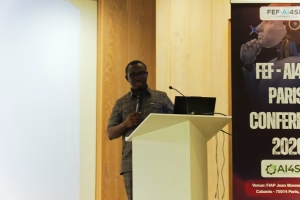
On the second day of the event, the Manager of the Remote Sensing and Climate Change Center of the Ghana Space Science and Technology Institute (GSSTI), Dr. Kofi Asare, delivered two presentations. His first presentation titled “From Pixels to Productivity: AI-Driven Crop Classification and Yield Prediction Using Earth Observation Data in Ghana”, focused on using satellite and Earth observation data to improve crop classification and predict yield for maize at the end of the season. The research demonstrated how AI can help farmers, agricultural planners, and policymakers make better decisions to boost productivity and strengthen food security.
Dr. Asare’s second presentation titled “AI-Driven Climate–Health Modelling for Malaria and Diarrhoea Disease Burden under Future Climate Scenarios in Ghana”, explored the intersection of climate change, public health data and AI tools to project disease burden by midcentury. The study examined how changing climatic conditions could influence the future burden of malaria and Diarrhoea in Ghana. The work underscores the potential of artificial intelligence to support early warning systems and inform public health interventions in a changing climate.
Another important presentation was delivered on the third day by the Manager of the Applied Radiation Biology Centre of the Radiological and Medical Sciences Research Institute (RAMSRI), Dr. Shadrack Donkor, on healthcare novelty, titled “Wound Healing Potential of Moringa oleifera Extracts in Normal Tissue Following Preoperative Radiotherapy: An AI-Assisted Phytochemical Compound Prediction Approach”, where he showed the wound-healing properties of Moringa oleifera extracts following preoperative radiotherapy. The study demonstrated how artificial intelligence can accelerate biomedical research and support the search for effective therapeutic solutions by incorporating AI-assisted Phytochemical Compound predictions.
Additionally, the Deputy Director of the Ghana Space Science and Technology Institute (GSSTI), Dr. Theophilus Ansah-Narh, whose presentation introduced a novel AI approach known as GLIMPSA: Global-Local Inference Method for Patch-based Spatial Anomalies in Medical Imaging, used for detecting spatial anomalies in medical images, demonstrated that the technology has the potential to enhance medical diagnosis and improve the accuracy of image-based healthcare assessments.
On the last day of the conference, the Deputy Director General of Ghana Atomic Energy Commission, Prof. Francis Hasford, highlighted the importance of partnerships and strategic investments in AI development. His presentation was titled “Building Institutional AI Capacity at GAEC Through Strategic France–Ghana Collaborative Partnerships”. He presented on efforts being made to strengthen GAEC’s institutional AI capacity through collaborative partnerships especially those between Ghana and France and emphasized the value of international cooperation in developing the skills, infrastructure, and research networks needed to advance AI innovation.
In another presentation, titled “Integrating Nuclear Science and Artificial Intelligence for Precision Health and National Development in Ghana: The Role of RAMSRI”, the Director of the Radiological and Medical Sciences Research Institute (RAMSRI), Dr. Theodosia Adom, explored how artificial intelligence can complement nuclear science to deliver more precise healthcare solutions and contribute to national development goals through their work at RAMSRI and the associated opportunities created by these advanced technologies.
The last presentation by GAEC was given by the Director of the Ghana Space Science and Technology Institute, Dr. Joseph Bremang Tandoh, titled “From Satellites to Solutions: How AI is Transforming Space Science, Technology and Sustainable Development”, he demonstrated how satellite data combined with AI can support environmental monitoring, disaster management, resource planning, and broader sustainable development efforts.
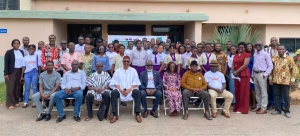
The conference brought together researchers, policymakers, and technology experts from around the world to explore how AI can be harnessed to support sustainable development.
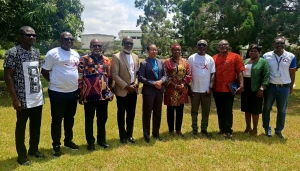
Ghana was represented by scientists from the Ghana Atomic Energy Commission, the Kwame Nkrumah University of Science and Technology (KNUST), University of Cape Coast, and the Ministry of Foreign Affairs.
By: CPRC/CCD