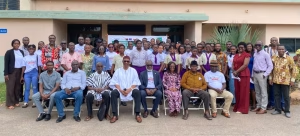
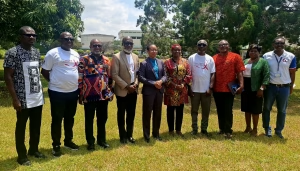
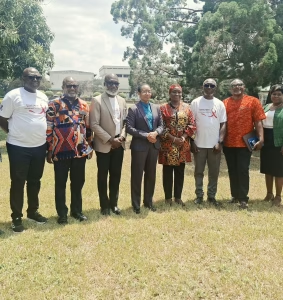
Ghana’s Ambassador to Austria and Permanent Representative to the United Nations in Vienna, Her Excellency Matilda Aku Alomatu Osei-Agyeman has paid a working visit to the Ghana Atomic Energy Commission (GAEC) in Accra.
The visit gave the Ambassador the opportunity to familiarize herself with the Commission’s research activities, infrastructure, scientific expertise, and contributions to national development through nuclear science and related technologies.
Welcoming the Ambassador, the Director General of GAEC, Prof. Samuel Boakye Dampare, expressed his delight at receiving her at the Commission, describing the visit as significant in reinforcing the longstanding collaboration between GAEC and Ghana’s Mission in Vienna.
Prof. Dampare noted that the cordial relationship between GAEC and the Mission has played a pivotal role in advancing Ghana’s participation in international nuclear cooperation and the activities of the International Atomic Energy Agency (IAEA).
“We are honoured to welcome you to GAEC. Your support and the hospitality consistently extended to our staff whenever they visit Vienna are deeply appreciated. We are pleased that you have taken the opportunity to visit us and witness first-hand the breadth of work we undertake to support Ghana’s socio-economic development through nuclear science and technology,” he said.
Addressing GAEC Management, Ambassador Osei-Agyeman expressed appreciation to the leadership and staff of GAEC for the warm reception, noting that her decision to visit GAEC was motivated by her desire to gain a better understanding of the Commission’s operations to represent Ghana more effectively at the IAEA and other international platforms.
“I have been in Vienna for a little over a year, and I felt it was important to come and see for myself what GAEC does. When I speak about Ghana’s achievements in nuclear science and technology, I want to do so from first-hand knowledge,” she stated.
She praised GAEC for its consistent technical support to Ghana’s Mission in Vienna, highlighting that the Commission has always responded promptly whenever expert information was required for international engagements.
“Whenever I ask for guidance or technical information, it comes within record time. That support gives me confidence whenever I represent Ghana at international discussions,” she noted.
She added that her visit would enable her to better appreciate the Commission’s achievements, understand its challenges and improve advocacy for Ghana’s nuclear science agenda on the international stage.
Delivering an overview of the Commission, the Deputy Director General of GAEC, Prof. Francis Hasford, highlighted the Commission’s broad mandate and growing contribution to national development through research, innovation, capacity building and specialised technical services.
“Over the years, the Commission has screened more than 3,000 people for various cancers, trained hundreds of farmers and radiation professionals, monitored over 800 telecommunications base stations, tested hundreds of environmental samples for radioactivity and engaged thousands of students in science education programmes,” he stated.
He further highlighted GAEC’s facilities, including the Ghana Research Reactor-1 (GHARR-1) Centre, Gamma Irradiation Facility, Secondary Standards Dosimetry Laboratory and the Radioactive Waste Management Centre, all of which support research, healthcare, industry, and food preservation.
Prof. Hasford expressed appreciation to the Ambassador for her continued support and was optimistic that the visit would open new opportunities for deeper collaboration between GAEC, Ghana’s Mission in Vienna and the IAEA.
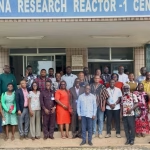
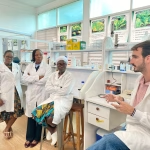
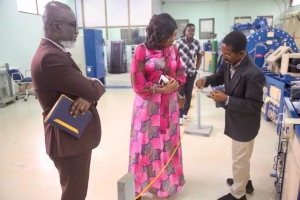
The Ambassador later toured selected facilities including the Ghana Research Reactor-1 (GHARR-1) Centre, the Personnel Dosimetry Laboratory, the Radioactive Waste Management Centre, the Accelerator Research Centre, the E2 Small Modular Reactor Simulation Centre, the GAEC AI Centre, the Plant Disease Research Centre and the Gamma Irradiation Facility to gain a first-hand appreciation of GAEC’s research, scientific infrastructure and innovative technologies.
By: CPRC/CCD