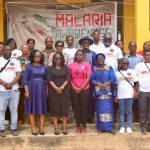
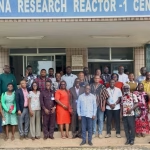
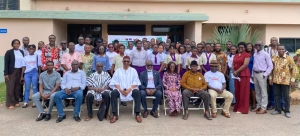
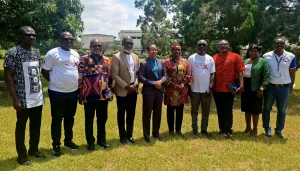
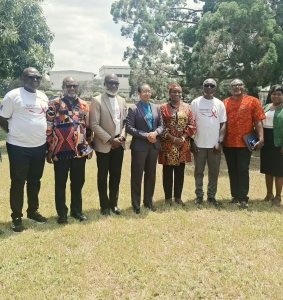
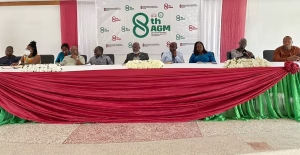
The Ghana Space Science and Technology Institute (GSSTI) of the Ghana Atomic Energy Commission (GAEC) hosted Japanese astronaut Dr. Koichi Wakata as part of efforts to inspire young Ghanaians to pursue careers in engineering and space exploration.
The event, dubbed the Astronaut and Strategic Partnership Meeting, was held at the Ghana Radio Astronomy Observatory (GRAO) under the theme, “From Ghana to Space: Building Africa’s Next Generation of Space Scientists and Explorers.”
The programme brought together staff, students, researchers and policymakers to discuss Ghana’s space development journey, opportunities for international collaboration and the future of space science in the country.
Delivering the welcome address, the Director of GSSTI, Dr. Joseph Tandoh, stated that Ghana’s space journey began in 2011 when the country joined the Square Kilometre Array (SKA) project, an international initiative aimed at developing the world’s largest radio telescope network.
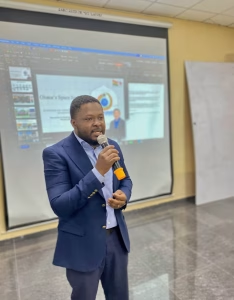
“Ghana successfully converted an abandoned satellite communication dish at Kuntunse into a functioning radio telescope, leading to the establishment of the Ghana Radio Astronomy Observatory in 2017. With support from Japan, Ghana also launched its first satellite that same year, marking a significant milestone in its journey towards becoming an active participant in the global space industry,” he explained.
Dr. Tandoh noted that Ghana had since developed a National Space Policy, which was approved by Cabinet and officially launched in 2024, while efforts continue to establish the legal and institutional framework required for its full implementation.
“Space technology already supports our daily lives through communication, navigation, weather forecasting and many other services. We want Ghana to move beyond being merely a consumer and become a contributor to the global space economy. This engagement with the renowned astronaut is intended to inspire scientists, researchers and students and encourage more young Ghanaians to pursue careers in space science and related fields,” he said.
Dr. Tandoh acknowledged that while sending a Ghanaian astronaut into space remains a long-term aspiration, the dream is achievable with sustained commitment and investment.
“If we invest in the right infrastructure, resources and human capital, Ghana can one day produce its own astronaut,” he added.
Addressing participants at the event, Dr. Koichi Wakata, who has flown to space five times and spent more than 500 days in orbit, described his visit as an opportunity to deepen collaboration between Ghana and international partners in the space sector.
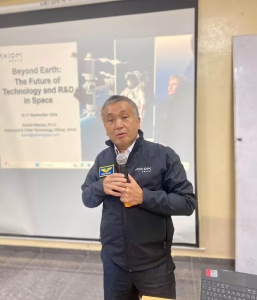
He noted that Ghana’s future in space lies in building local capacity in satellite development, operation and utilisation.
According to him, satellite technology has the potential to support critical sectors such as agriculture, fisheries, mining, environmental monitoring and disaster management through satellite imagery, data collection and real-time monitoring.
“As I mentioned earlier, I witnessed the deployment of Ghana’s first satellite from the International Space Station in 2017. It is important for Ghana to continue expanding its capabilities in satellite production, operation and utilisation,” he stated.
He encouraged Ghanaian students to take advantage of opportunities in space research, suggesting that student-led experiments could be sent to space as a cost-effective means of promoting science education and innovation.
“Student experiments can be sent to the International Space Station. Even simple projects, such as growing plants in space, can be exciting and inspiring for young people. I believe selecting experiments through national competitions and sending them to space would be a cost-effective way to promote science education and build capacity in space science and technology,” he said.
He emphasised that international cooperation remains essential for any country seeking success in space exploration.
“It is very difficult to do it on your own. You need partners, and that is why collaboration is important,” he added.
Speaking on her experience, a final-year student of Kwabenya Community Senior High School, Ms. Okyere Margaret Afia Boaduwaa, said the programme had inspired her despite her interest in medicine rather than astronomy.
“Today I got to meet a real astronaut and participate in the programme. It has inspired me because I now see how everything is connected through science and technology,” she said.
Another student participant from the GAEC Basic School, Mr. Jeremy Sosu, described meeting Dr. Wakata as a dream come true and said the interaction had strengthened his interest in science. He expressed hope that the experience would inspire more young people to pursue careers in science, technology, engineering and mathematics (STEM).
The engagement formed part of GSSTI’s efforts to promote science education, strengthen international partnerships and inspire the next generation of Ghanaian scientists and innovators to contribute to the country’s growing space programme.
By: CPRC/CCD