Experts from Ghana Atomic Energy Commission (GAEC) and other leading State water institutions have raised concerns that poor infrastructure, pollution, weak governance and climate-related pressures are threatening the country’s long-term water security.
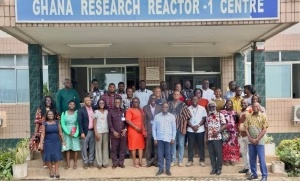
The concerns were raised at a national stakeholder meeting hosted by GAEC under the International Atomic Energy Agency (IAEA) RAF 7024 Project, titled; “Accelerating the Use of Isotope Hydrology in Water Resources Management in Africa.”
The meeting brought together researchers, academics, regulators and water-sector practitioners to discuss the growing pressures on Ghana’s water resources, including failing rural water systems, groundwater contamination, illegal mining, climate variability and weak monitoring systems.
Presentations delivered by Dr. Joseph Ayer, Chief Hydrogeologist of the Community Water and Sanitation Agency (CWSA); Prof. Samuel Y. Ganyaglo, Director of the National Nuclear Research Institute (NNRI), Ghana Atomic Energy Commission, and Project Counterpart; Engr. Dr. Collins Okrah, Senior Research Scientist at the Council for Scientific and Industrial Research – Water Research Institute (CSIR-WRI); and Dr. Jesse P. Kazapoe, Head of the White Volta Basin at the Water Resources Commission (WRC), collectively highlighted the urgent need for reforms to safeguard Ghana’s water future.
Speaking on “Rural Water Supply in Ghana,” Dr. Joseph Ayer highlighted significant progress in rural water access over the past three decades.
“Rural water coverage increased from 27% in 1990 to 60% by 2025, supported by the construction of over 39,000 boreholes, 1,500 mechanised water systems, and more than 500 small-town piped water systems”, he revealed.
Despite these achievements, he warned that the sustainability of rural water services is at risk due to limitations of the Community Ownership and Management (COM) model.
“Many communities lack the technical, financial, and managerial capacity to maintain increasingly complex water systems, leading to breakdowns, poor maintenance, financial challenges, and inadequate revenue generation”, he said.
He added that out of the 355 water systems currently managed by community-based water and sanitation (WATSAN) teams, only 259 are functional, while 96 have failed because of issues such as pump breakdowns, abandoned boreholes, electricity disconnections, damaged infrastructure, leaking storage tanks, and water quality concerns. Dr. Ayer estimated that GHC 976 million (US$81.3 million) is needed to rehabilitate these systems and restore safe water access in affected communities across 59 districts.
In another presentation, the project counterpart, Prof. Samuel Y. Ganyaglo, presented findings from an isotope hydrology-based groundwater research conducted under an International Atomic Energy Agency-supported project, where particular attention was drawn to emerging groundwater quality challenges in northern Ghana.
The research focused on the Upper Volta and Oti basins, where isotope and hydrogeochemical techniques have been deployed to understand groundwater recharge processes, contamination sources and climate-related vulnerabilities.
Prof. Ganyaglo reported that elevated nitrate levels have been detected in parts of the crystalline basement aquifers of the Upper Volta Basin, while excessive fluoride concentrations in some areas have led to the closure of wells.
“One of the most significant findings of the research is that agricultural manure is the dominant source of nitrate contamination in many groundwater systems. The studies also revealed that some aquifers contain water recharged under ancient climatic conditions, requiring careful regulation of abstraction to prevent groundwater mining” he revealed.
He called for stricter regulation of manure application on farmlands to prevent further degradation of water quality and further noted that groundwater contributes significantly to river flows during dry periods, sustaining surface water availability for irrigation and food production.
Prof Ganyagloh stressed the importance of isotope hydrology in providing critical scientific evidence that can support national water-resources planning and enhance sustainable management of both groundwater and surface-water systems.
“Significant gaps remain in understanding groundwater-surface water interactions and the full impact of illegal mining on groundwater resources. To close these gaps, we propose long-term monitoring of rainfall, surface water and groundwater using isotope hydrology techniques across key areas of the Volta Basin”, he suggested.
Providing a broader national perspective, Engr. Dr. Collins Okrah of CSIR-WRI warned that although Ghana is not yet experiencing a nationwide groundwater crisis, the country’s freshwater security is becoming increasingly vulnerable.
In his presentation on the status of Ghana’s groundwater resources, he observed that groundwater remains a strategic resource for rural water supply, agriculture, industry and ecosystem sustainability.
“Groundwater accounts for approximately 96 percent of the world’s available freshwater resources and serves as a critical buffer during periods of drought and seasonal water shortages”, he said.
Dr. Okrah identified a range of threats facing Ghana’s aquifers, including uncontrolled groundwater abstraction, drought, declining recharge rates, salinity intrusion, urbanisation and inadequate monitoring.
He highlighted illegal mining, popularly known as galamsey, as a major driver of water pollution, environmental degradation and aquifer disturbance, warning that its impacts extend beyond rivers to groundwater systems.
Citing recent water resource assessments, Dr. Okrah stated that Ghana’s water stress level has declined from about 1,900 cubic metres per person in 2016 to approximately 1,500 cubic metres per person in 2025, reflecting growing pressure on the country’s freshwater resources.
“Continued pollution and mismanagement could lead to rising treatment costs, intensify competition among domestic, agricultural and industrial users, and potentially force the country to invest in costly alternatives such as desalination and long-distance water transfers” he added.
Another major concern raised by Dr. Okrah was the absence of a comprehensive national groundwater monitoring system. Adding, “We cannot manage what we cannot measure.”
He argued that Ghana urgently needs a permanent national observation network to track groundwater levels, recharge dynamics, abstraction rates and water quality trends across major aquifers and river basins. He further proposed the establishment of a Ghana National Groundwater Observation Network and called for groundwater to be officially recognised as a strategic national freshwater-security resource.
The policy dimension of water resources management in Ghana was outlined by Dr. Jesse P. Kazapoe of the Water Resources Commission and stressed that water security is fundamentally linked to governance, regulation and effective implementation of policy.
He noted that water supports domestic supply, agriculture, industry, energy production, ecosystems and public health, making its sustainable management a prerequisite for national development.
“Ghana’s policy focus must shift from merely providing more water to ensuring that water resources are secure, sustainable and equitably governed”, he noted.
Dr. Kazapoe identified several emerging pressures on Ghana’s water resources, including illegal mining, wastewater discharge, catchment degradation, droughts, floods, land-use changes, infrastructure deficits and growing competition among water users. He therefore underscored the importance of groundwater, particularly in the White Volta Basin, where groundwater constitutes more than 80 percent of safe water supplies in some communities.
He further cited studies within the Volta Basin showing severe contamination in upstream and midstream tributaries, where illegal mining and sand-winning activities have contributed to elevated turbidity and the presence of contaminants such as cadmium, lead, chromium and cyanide.
“These findings reinforce the need for stronger enforcement of environmental regulations, integrated water-resources management and sustained investments in watershed protection and monitoring systems”, he said.
The consensus emerging from the presentations is that Ghana still has an opportunity to avert a future water crisis. However, doing so will require decisive investments in infrastructure rehabilitation, groundwater protection, scientific monitoring, pollution control, stronger enforcement of regulations and institutional reform.
By: CPRC/CCD