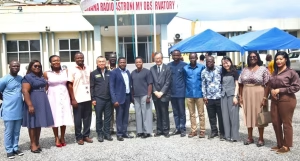
The Biotechnology and Nuclear Agriculture Research Institute (BNARI) of the Ghana Atomic Energy Commission (GAEC) has organized the 2026 Malaria Awareness Campaign (MAC 26) at Taifa Community Cluster of Schools, Ga East Municipality, Accra.
The campaign, coordinated by Dr. Enoch Selorm Kofi Ofori, Manager of the Radiation Entomology and Pest Management Centre of BNARI-GAEC, aimed to educate the public on malaria prevention, control, screening, and treatment. It brought together students, health professionals, researchers, community members, and other stakeholders to discuss strategies for combating malaria and promoting healthier communities.
The event, organized in partnership with key stakeholders, forms part of BNARI-GAEC’s commitment to giving back to society and supporting national efforts to reduce the incidence of malaria through public education and community engagement.
Addressing participants, the Director of BNARI, Prof. Michael Osae, warned that changing mosquito behaviour is creating new challenges for malaria control efforts.

He noted that mosquitoes are increasingly biting both indoors and outdoors, making it necessary to complement traditional interventions such as insecticide-treated bed nets with additional protective measures.
“For many years, our primary focus has been indoor mosquito biting. Today, we are seeing mosquitoes adapt by biting outdoors and at unusual times of the day, reducing the effectiveness of interventions designed solely for indoor protection while people are in bed,” he said.
Despite these challenges, Prof. Osae emphasized that sleeping under insecticide-treated bed nets remains one of the most effective malaria prevention strategies. He stated that bed nets continue to save lives and must remain a central pillar of malaria prevention and every household should ensure that vulnerable groups, especially children and pregnant women, consistently sleep under treated nets.
Drawing attention to the evolving nature of the malaria challenge, Prof. Osae described mosquito adaptation as part of an ongoing coevolutionary struggle between humans and disease vectors.
“What we are witnessing is a coevolutionary arms race. As humans develop new methods to control mosquitoes, mosquito populations adapt their behavior to survive. Our response must therefore be continuous innovation and vigilance,” he said.
He further highlighted the growing challenge of residual malaria transmission, which persists even in communities with high coverage of established interventions.
Prof. Osae therefore called for increased adoption of mosquito repellents as an additional layer of protection against outdoor-biting mosquitoes. Noting that personal repellents could provide critical protection for people who spend time outdoors during peak mosquito biting hours. He added that innovations such as the Med Share Mosquito Repellant, which has been tested by GAEC, demonstrate the important role local research and industry can play in malaria prevention.
Addressing environmental control measures, he stressed the importance of eliminating mosquito breeding grounds before mosquitoes mature into adult vectors by paying greater attention to larval source management through clearing stagnant water, improving sanitation and targeted treatment of breeding sites.
Prof. Osae also underscored the need for stronger social and behavioral change interventions, particularly in settings where people gather during the evenings.
“Malaria control is not only about science and technology but also about human behaviour. Open-door churches, pubs, night food vending centres and other social gathering places should be encouraged to adopt measures that reduce exposure to mosquito bites”, he added.
Prof. Osae further urged stakeholders to strengthen collaboration among researchers, policymakers, healthcare workers and communities to accelerate progress towards malaria elimination.

Also speaking at the programme, the Municipal Director of Education for Ga East, Mr. Eric Sey, commended BNARI-GAEC for organising the awareness campaign and described it as a timely intervention in the fight against malaria. According to him, programmes of this nature play a critical role in educating school children and communities on preventive health practices and contribute significantly to improving public health outcomes.
“Malaria remains one of the leading causes of illness among school-age children, affecting attendance, academic performance and the general well-being of our learners. Educational institutions therefore have an important role to play in promoting awareness and prevention,” he stated.
Mr. Sey appealed to the Ministry of Education to strengthen its support for school-based health awareness programmes, noting that such interventions play a critical role in educating learners on disease prevention.
He further cautioned against the dangers of malaria and urged community members to seek prompt medical attention whenever symptoms are detected, adding that malaria is a serious disease that can lead to severe illness and even death if left untreated.
“We must discourage self-medication and encourage individuals to seek early diagnosis and treatment at recognised health facilities. Early treatment saves lives and helps prevent complications,” he advised.
Mr. Sey also encouraged students to serve as ambassadors of malaria prevention by sharing information acquired during the programme with their families and communities.
The Head of the Vector Control Unit of the National Malaria Elimination Programme (NMEP), Madam Otubea Owusu Akrofi, in a statement also stressed that malaria prevention is both an individual and collective responsibility.
She noted that while government and health institutions continue to implement interventions to reduce malaria transmission, communities and individuals must also play their part by adopting preventive measures and maintaining clean environments.
Madam Owusu Akrofi emphasized that one of the most effective ways of preventing malaria is the elimination of mosquito breeding sites, many of which are found around homes and public spaces and called on community members to work collectively to maintain clean neighbourhoods, explaining that “the actions of one household can affect the health and safety of an entire community”.
“A clean environment benefits everyone. When communities come together to eliminate breeding sites, they significantly reduce mosquito populations and lower the risk of malaria transmission. Malaria prevention therefore requires a shared commitment from all of us,” she added.
Madam Owusu Akrofi also encouraged participants to consistently adopt preventive measures such as sleeping under insecticide-treated bed nets, using repellents where necessary and seeking prompt treatment whenever symptoms of malaria occur.
Present at the programme were the Headteacher of Taifa Community 1 Basic School, Mr. Godfred Tenkorang; the Headmistress of Taifa Community 2 Basic School, Madam Dorcas Tetteh; and the Headteacher of Taifa Community 3 Basic School, Mr. Morris Quaye.
Also in attendance were the medical team from Taifa Polyclinic; the Deputy Director of BNARI, Prof. Samuel Amiteye; Dr. Dinah Marri, Research Scientist at GAEC; Dr. Ekene Nwaefuna, Research Scientist at GAEC; Dr. Irene Opoku Ntim, Research Scientist at GAEC; Dr. Mark Kwasi Sarfo, Head of Communications and Public Relations at GAEC; Mr. Bright Courage Agbodza, Auditor at BNARI; Mr. Theodore Odame Saforo, Acting Administrator of BNARI; and Mrs. Doris Esi Bigombi, Accountant at BNARI, as well as several other distinguished officials.
By: CPRC/CCD