President Nana Akufo-Addo says Ghana is envisioning nuclear energy to account for 30 percent of the country’s energy mix by 2070.
This would ensure the provision of clean and affordable electricity to drive the country’s industrialisation agenda.
“It is also meant to position Ghana as a net power exporter in the ECOWAS region through the West African Power Pool,” he said.
President Akufo-Addo made the statement when delivering the 2024 State of the Nation Address to Parliament.
He stated that his remark was an extension of what he said at the US-Africa Nuclear Energy Summit and the International Framework for Nuclear Energy Co-operation (IFNEC) Ministerial Conference, which took place in Accra in November last year.
“We have committed ourselves to the development of nuclear energy for peaceful purposes,” he added.
Nuclear energy comes from splitting atoms in a reactor to heat water into steam, turn a turbine and generate electricity.
According to the International Atomic Energy Agency, nuclear is a low carbon emitting source of energy apart from being a clean, reliable, affordable, and modern energy source.
Available data indicates that the total installed capacity for existing plants in Ghana is 5,134 Megawatt (MW), with a dependable capacity of 4,710 MW.
Thermal generation accounts for the largest share of Ghana’s power generation, representing 66 percent, with hydro accounting for 33 percent.
Ghana’s thermal power generation is fuelled largely by natural gas, but occasionally using light crude oil and diesel. Ghana exports power to Togo, Benin, and Burkina Faso.
Source: GNA
Forty staff of the Ghana Atomic Energy Commission (GAEC) have completed a four-day competency-based training (CBT) and its implementation process at a workshop in Accra last Thursday.
The workshop is aimed at enhancing the teaching abilities of GAEC staff as facilitators to provide learners with the appropriate knowledge and skills to efficiently perform workplace roles in industry and administration.
This forms part of a pact between the GAEC and the Commission for Technical and Vocational Education and Training (CTVET) in 2023 under the Ghana TVET Voucher Project (GTVP), for which GAEC is to provide competency-based training and assessment in welding and fabrication as well as consumer electronics for national proficiency I and II.
In a speech to open the four-day capacity-building workshop, the Director-General of the GAEC, Prof. Samuel Boakye Dampare, explained that the GAEC availed itself to collaborate with CTVET to fulfill one of its mandates, which is to facilitate education and training activities at various levels within its area of expertise and to transfer technologies.
“The Commission is therefore delighted to fulfill its obligation in contributing to national development by sharing its expertise and experience to generate long-term employment opportunities,” he added.
Prof. Dampare described the workshop as a trainer-of-trainers exercise and indicated that it kickstarts the process of building and enhancing the competencies of artisans in electronics and welding for their employability and entrepreneurship while urging participants to take every lesson seriously.
He expressed his appreciation to the GAEC team for their vision, creation of the concept paper, and diligent work in preparing and submitting the proposals that resulted in GAEC being granted a service contract to provide skills and knowledge in a specific trade and vocation for sustainable job creation.
“I will therefore entreat the project coordinator and the managers to do their best in implementing the project successfully per the contract terms, to the satisfaction of partners and sponsors, and to GAEC’s credit,” he added.
On her part, the Project Coordinator of TVET at GAEC, Mrs. Sheila Frimpong Mensah, thanked CTVET for their continuous collaboration and assured them of quality service delivery.
“We have done it before, and we will do it even better this time. I call on my colleagues that we meet and exceed expectations”, she noted.
Participants were taken through the TVET transformational system in Ghana, the CBT concept and package, the eight levels of the national TVET qualification framework, the CBT program structure, assessment, and verification, among others.
The National Nuclear Research Institute (NNRI) of the Ghana Atomic Energy Commission (GAEC) held a seminar for research scientists to bridge the gap between innovations and practical applications.
The objective of the seminar was to equip the researchers with strategies and insights to help navigate the path from laboratory discoveries to the commercialisation of their work.
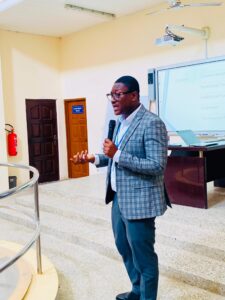
In his presentation, the Director of Commercialisation and Communication Directorate (CCD) of GAEC, Nana Boateng, stated that scientists must brainstorm ideas that can be commercialised before the start of their research.
The Director of Commercialisation and Communication Directorate (CCD) of GAEC, Nana Boateng giving his presentation at the seminar
“Thinking about commercialisation early in the research process will encourage you to match your work with industrial or everyday use. This mindset will prompt you to identify potential implications of your findings in real-world scenarios” he said.
Nana Boateng emphasised the importance of intellectual property protection for researchers, particularly in fields as dynamic as those explored by the Commission’s research scientists.
“Patents are more than just legal safeguards; they are a strategic move to ensure that both innovators and investors can confidently and profitably engage in the development and commercialisation of game-changing technologies” he stated.
He urged the scientists to adopt the mindset of innovators and entrepreneurs in addition to being researchers.
“The scientists cannot do it alone. That is why it is important for them to collaborate with CCD so that we can journey with them from the beginning to ensure the successful commercialisation of their innovations and technologies” he added.
On his part, the Director of NNRI, Dr. Samuel Ganyaglo expressed his hope that the scientists would leave the programme with new insights into how to translate their research findings into useful innovations that will help grow the Ghanaian economy and GAEC in particular.
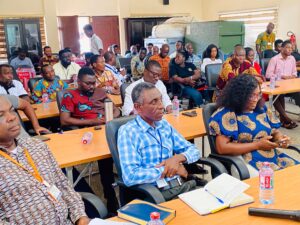
Staff members at the seminar
“Intellectual property (IP) and research commercialization are important topics to me as a scientist and Director. It’s clear from the information received from this seminar that we can profit greatly from intellectual property. We can make a lot of money if our scientists are able to patent their ideas and we have an IP policy in place that allows them to do so” he stated.
In his closing remarks, the Chairman for the day, Dr. Dennis Kpakpo Adotey expressed gratitude to the scientists for their participation in the seminar and urged the Director of CCD to collaborate with GAEC Management in the strengthening of the IP policy.
The Ghana Atomic Energy Commission held its 17th Annual Thanksgiving Service with a call on members of staff to appreciate the grace of God in their lives.
The sermon for this year’s service was del ivered by Very Rev. Eric Gyan (Director, Youth Ministries Directorate of the Methodist Church Ghana) on the theme: Celebrating the Goodness of God.
The Director General of GAEC, Prof. Samuel Boakye Dampare took the opportunity to highlight the commission’s key achievements in 2023. In a heartfelt address, he expressed gratitude to the dedicated members of staff for their unwavering commitment to their work.
The celebration was captured in a series of photographs, offering a visual glimpse into the event and the spirit of thanksgiving that prevailed.
A Principal Technologist at the Radiation Protection Institute (RPI) of the Ghana Atomic Energy Commission, Ms. Bernice Agyeman has received the L’OREAL FOUNDATION-UNESCO YOUNG SCIENTIST AWARD for her PhD. research on the Quality of Drinking Water to Address Disease Risk. She was one of 30 young scientists chosen from 630 individuals who applied for the award.
The Biotechnology and Nuclear Agriculture Research Institute (BNARI) of the Ghana Atomic Energy Commission (GAEC) is set to inaugurate an experimental hut station for innovative research in managing malaria-transmitting mosquitoes in a rural community in the Ashanti Region of Ghana.
The experimental hut station, which is located at Atatem in the Adansi Asokwa District, is a simplified model of an indigenous home, built to World Health Organization (WHO) standards that will allow researchers to test the efficacy of insecticides used in indoor residual spray (IRS) and long-lasting insecticidal nets (LLINs) to kill disease vectors such as Anopheles gambiae and Anopheles funestus.
The Director of BNARI, Dr. Michael Osae, made this known yesterday when he interacted with communication personnel to announce a host of activities earmarked for the 2023 annual GAEC-BNARI Malaria Awareness Campaign (MAC-2023) slated for 9th May 2023.
Director of BNARI, Dr. Michael Osae
According to Dr. Osae, the decision to establish the hut in the Atatem community stems from prior research, which indicates that mosquito vectors of malaria are prevalent and highly resistant to insecticides. Premised on this fact, he said there is a good foundation for siting the experimental hut to test new vector control tools being developed against resistant vectors.
“Mosquito nets would be hung in the experimental hut to collect mosquitoes for the test. The mosquitoes will then be examined to determine the effectiveness of vector control tools like treated nets and insecticide sprays,” he added.
Dr. Osae stated that the experimental hut station is a highly effective way to eliminate non-responsive control measures and validate new and appropriate interventions to help control disease-transmitting mosquitoes.
“This project was established in collaboration with the Center for Research in Infectious Diseases in Cameroon through a Bill and Melinda Gates Foundation grants. The Center for Research in Infectious Diseases of Cameroon were awarded a Bill & Melinda Gates Foundation grant to study mosquito insecticide resistance and its impact on vector control tools across Africa. The participation of Ghana in the project enabled GAEC to be given a sub-grant to carry out this component,” he added.
Shedding light on some key activities of the awareness campaign, Dr Osae said that apart from the commissioning of the experimental hut station, there would be an awareness talk to educate community members in Atatem and its environs on malaria prevention and control.
He also indicated that there would be a free health screening exercise and distribution of free mosquito repellents for residents.
The GAEC in partnership with the European Union, the United Nations Interregional Crime and Justice Research Institute (UNICRI) and the International Atomic Energy Agency (IAEA) have organized a 3-day workshop on organized criminal activities using Nuclear and other Technologies in Accra.
The workshop was focused on the Prevention, Detection and Response to Chemical, Biological, Radiological and Nuclear (CBRN) Terrorism. It was designed to discuss the role that technology solutions play on organized criminal activities that breach the integrity of the supply chain. With particular emphasis on collecting feedback from CBRN experts, law enforcers, forensic and supply chain technology experts.
It was also to help identify needs of operators in the field and the ways in which technology can support their activities for the monitoring, prevention and investigation of illegal activities related to CBRN terrorism and criminal infiltrations of the supply chain.
Participants in the workshop on organized criminal activities using Nuclear and other Technologies.
The Minister of Environment, Science, Technology and Innovation, Dr. Kwaku Afriyie, who gave the keynote address, noted that in the west African sub-region, organized criminal activities are known to have had influences in fake medicines, illegal mining, illegal fishing, fuel adulteration and smuggling sectors.
“Left unresolved, the threats posed by these activities can have devastating consequences not only in terms of human lives, but also in terms of economic and social stability”, he added.
The Minister emphasized that prevention is the foremost objective in the fight against malicious or criminal activities involving CBRN. “It is the key to addressing the threats posed by CBRN terrorism and organized criminal activities” he added.
He indicated that technologies such as radiation detection systems, biometric scanners, and chemical sensors can be deployed around the world as one of the most effective ways to prevent these threats.
Dr. Kwaku Afriyie added that detection and response which involves the use of technologies such as remote sensing, imaging systems, and mobile laboratories as well as drones, robots, and autonomous vehicles can be used to respond to threats quickly and safely in areas that are difficult to access.
He concluded by saying that Ghana’s efforts to prevent, detect and respond to organized crime requires technology and proactive collaboration between government agencies, private industry, civil society organizations and academic and research institutions.
The Deputy Director General of the Ghana Atomic Energy Commission, Prof. Dickson Adomako, who represented the Director General, Prof. Samuel Boakye Dampare, said that Ghana has a rich history with the United Nations and the International Atomic Energy Agency on collaborations to drive research, development, human resource capacity building and safety and security matters.
“We are therefore happy to be hosting this 3-day United Nations Interregional Crime and Justice Research Institute workshop, which has brought together experts from around the world” he added.
Prof. Adomako revealed that the prospect of non-state actors including terrorists gaining access to and using Chemical, Biological, Radiological and Nuclear materials is a serious threat to international peace and security.
“The activities of such groups are on the rise and more effort is needed to address this kind of injustice to humanity” he said.
He was particularly happy that this workshop is being organized in Ghana to discuss measures to curtail these criminal activities due to reports of the ascendency of terrorism and organized crime activities in Africa.
“I know that experts will give us more examples of CBRN terrorism and organized crime activities during this workshop” he added.
Participants were drawn from Ghana, Cote d’Ivoire, Liberia, Nigeria, and Sierra Leone with particular emphasis on CBRN terrorism experts as well as customs and law enforcement officers with expertise on different forms of illicit trade (related to trafficking in illicit pesticides, fuel frauds, precious metals trafficking, illegal, unreported, and unregulated (IUU) fishing and forensic and supply chain technology experts.
By: Communication and Public Relations Center, GAEC
The Biotechnology and Nuclear Agriculture Research Institute (BNARI) of the Ghana Atomic Energy Commission (GAEC) has launched the maiden edition of the Cassava Week Celebration to promote the value of cassava cultivation and utilization in Ghana.
The week celebration, which is on the theme: “Cassava – Ghana’s Golden Root for Economic Transformation’’ is aimed at raising awareness amongst Ghanaians regarding the rich diversity and benefits of the cassava crop. It is scheduled to take place from the 13th – 16th of June 2023 at the Ghana Atomic Energy Commission (GAEC), Accra and the Innovation Village Foundation at Anormawobi in the Central Region.
Cross-section of GAEC staff and guests at the launch of the Commission’s Cassava Week Celebration
In a speech read by the Director of the Ghana Space Science and Technology Institute, Prof. Shiloh Osae, on behalf of the Director General of GAEC, Prof. Samuel Dampare, he emphasised that this programme was part of GAEC’s efforts to support the government of Ghana for the utilization of Science, Technology and Innovation (STI) to improve cassava varieties for national development. “Whiles research works are endless, the rate of adoption and utilization of the technologies developed needs to be improved in Ghana”, he added.
In his keynote address, the Managing Director of Ayensu Starch Company Limited, Mr. Evans Kwame Ayim, noted that more than 70 % of farmers in Ghana are involved in the production of cassava, making it a significant root crop in the country’s agricultural system.
He stated that cassava is a major source of carbohydrates for most people in Ghana, as well as a regular source of income for most rural dwellers.
According to Mr. Ayim, although cassava is mostly thought of as a food crop, encouraging local processing and consumption of cassava-based products will generate income for households and create jobs for the Ghanaian economy.
Cross-section of GAEC staff and guests at the launch of the Commission’s Cassava Week Celebration
“The potential of cassava as an industrial crop cannot be overemphasized. Ghana’s economy stands to benefit greatly if steps are taken to industrialize cassava. Cassava can be processed into starch, ethanol, high maltose syrup, etc”, he revealed.
He also added that Globally the starch industry is worth over $97billion US Dollars which the country can take advantage of..
Mr. Ayim expressed appreciation for BNARI’s research initiatives which have yielded significant results in the development of high yielding cassava varieties for farmers.
“BNARI in collaboration with University of Cape Coast, has released to farmers, five high yielding cassava varieties namely Nyonku agbeli, Kponu agbeli, Fufuhene bankye, Ampesihema bankye and Tetteh bankye. However, these varieties have not been adopted widely by farmers due to inadequate publicity and unavailability of planting materials. Hence, the expected socioeconomic impact on farmers have not been realized” he said.
He urged BNARI to form partnerships with industry players that will make their cassava varieties available and accessible to farmers, allowing them to produce enough raw materials for Ghana’s few cassava processing factories as well as the local market.
On his part, the Director of BNARI, Dr. Michael Osae stated that Cassava has the potential to transform Ghana’s economy because it can be used in sectors like the pharmaceutical, beverage, and textile industries.
He stated that the Institute chose to emphasize cassava in honour of its 30th anniversary to highlight BNARI technologies and innovations in the cassava value chain.
“BNARI has developed technologies such as Mutation Breeding for breeding new varieties of cassava and other crops, soil moisture and nutrient management, crop and pest disease management which are technologies that can be applied to improve cassava production. We have also worked on fortifying gari with micronutrients and soybeans to develop a soybean-gari blend known as “proGari” he added.
The Keynote speaker later launched the Cassava Week Celebration followed by an exhibition event to showcase the various BNARI products and technologies.
The Ghana Atomic Energy Commission (GAEC) is collaborating with the Centre for Plant Medicine Research (CPMR) to facilitate the large-scale production and cultivation of a medicinal plant for rheumatoid arthritis.
Capparis erythrocarpos Isert is an important medicinal plant used to produce “Sirrapac”, a herbal product for the management of the disease.
The partnership calls for GAEC’s Biotechnology and Nuclear Agriculture Research Institute (BNARI) to develop protocols for multiplying some recalcitrant medicinal plants using tissue culture technology.
The Director-General of GAEC, Prof Samuel B. Dampare expressed confidence that this project will address an important limitation in the production of such herbal plant medicine, which is the scarcity of the plant raw material due to urbanization and deforestation of natural habitats.
In an interview with staff of the Communication and Public Relations Centre (CPRC), the Director of BNARI, Dr. Michael Osae stated that tissue culture technology can be used to produce high quality and disease-free planting materials of crops and medicinal plants.
He said that BNARI and CPMR have been in discussions on how to leverage biotechnologies such as tissue culture for rapid and large-scale multiplication of important medicinal plants that are on the verge of extinction but critical to CPMR’s work.
Following the signing of the Memorandum of Understanding (MoU), BNARI will initially develop tissue culture protocols for the large-scale production of Cappariserythrocarpos planting materials to aid establishment of plantation by CPMR” he said.
According to Dr. Wilfred Elegba, a Senior Research Scientist at the Biotechnology Centre of BNARI, the Capparis plant has useful medicinal properties that can treat rheumatoid arthritis.
He mentioned that the Centre for Plant Medicine Research has a herbal medicine product, “Sirrapac”. However, the CPMR is unable to meet the demand for “Sirrapac” due to insufficient quantities of the plant raw material for production.
“With BNARI’s nearly 30 years of experience in the development of plant tissue culture protocols for mass production of clean planting materials for food crops such as plantain, pineapple, sweet potato, sugarcane and medicinal plants such as Aframomum melegueta (alligator pepper) and Phyllantus niruri (Awommaa guwakyi), we look forward to assisting the Centre in expanding their production” he added.
On his part, the Executive Director of the Centre for Plant Medicine Research, Prof. Alex Asase expressed his profound gratitude to GAEC for its efforts in making the collaboration a reality.
He stated that through this collaboration, CPMR and GAEC will work to ensure the sustainability and availability of medicinal plants that are essential to the Centre’s work.
Research conducted by the Biotechnology and Nuclear Agriculture Research Institute (BNARI) of the Ghana Atomic Energy Commission (GAEC) has revealed that 25% of mosquito breeding sites in the Kwabenya area are home to Anopheles mosquitos, the main vectors of malaria.
Breeding sites around GAEC Community, Kwabenya-Musuku, Narhman (Bohye), and Kwabenya itself are among the 25% identified.
The Director of the Biotechnology and Nuclear Agriculture Research Institute (BNARI) of the Ghana Atomic Energy Commission (GAEC), Dr. Michael Osae, made this known when he shared the findings with the students and teachers of GAEC Basic School at GAEC’s annual Malaria Awareness Campaign at Kwabenya in Accra.
The research exercise began on April 28, 2022, and ended on May 10, 2022, as part of the one-month-long activities that marked the 2022 edition of the Malaria Awareness Campaign, which ended on May 31, 2022, with a public lecture on “Malaria and Malaria Mosquitoes”.
According to Dr. Osae, the study shows that the residents of Kwabenya and its environs are at risk of malaria because the mosquito species identified are competent vectors of human malaria.
“The remaining 75% of breeding sites were home to Culex and Aedes mosquitoes, also known as nuisance mosquitoes, which do not transmit malaria but do transmit other diseases that are not present in the country. They can, however, transmit yellow fever,” he explained.
Dr. Osae, therefore, recommended that residents of Kwabenya desilt the gutters, spray the mosquito breeding sites to kill the mosquito larvae, and, where applicable, get rid of the mosquito breeding sites entirely.
In another study conducted by BNARI during the same period on mosquito net ownership and usage in the Kwabenya community, Dr. Osae said it was found that 51% of the people do not have treated nets and only 63% of those who do sleep under them.
“We must all change our attitude towards how we think about mosquitoes and malaria. Your treated mosquito nets are not meant to fence your hencoop; please sleep in them to prevent malaria,” he stressed.
Speaking on the theme for the campaign “Harness Innovation to Reduce Malaria Disease Burden and Save Lives,” Dr. Osae said innovations have led to the development of a World Health Organization-approved Long-Lasting Insecticide Nets, which he described as “one of the best ways of preventing malaria as the net establishes a physical and chemical barrier against mosquitoes.”
On her part, the Municipal Chief Executive (MCE) of the Ga East Municipal Assembly, Hon. Elizabeth Kaakie Mann, said malaria remains a life-threatening disease, causing more than one million deaths each year.
She urged the public to avoid mosquito bites and reduce their risk of contracting malaria by keeping their surroundings clean and sleeping under treated mosquito nets.
“I will also recommend, especially to those who have not signed onto the National Health Insurance Scheme (NHIS), to do so as soon as possible since the scheme provides cover for malaria services at a low cost for holders of an NHIS card,” she added.
The campaign is an annual event that is aimed at empowering communities toward malaria prevention and control and helping solve the problem of malaria through research-driven solutions.




 The Director-General of GAEC, Prof Samuel B. Dampare expressed confidence that this project will address an important limitation in the production of such herbal plant medicine, which is the scarcity of the plant raw material due to urbanization and deforestation of natural habitats.

 The Director of the Biotechnology and Nuclear Agriculture Research Institute (BNARI) of the Ghana Atomic Energy Commission (GAEC), Dr. Michael Osae, made this known when he shared the findings with the students and teachers of GAEC Basic School at GAEC’s annual Malaria Awareness Campaign at Kwabenya in Accra.